Danny Yatom 8th Mossad Chief Interview Profiles In Intelligence
DannyYatom8thMossadChiefInterviewProfilesInIntelligence
Quote of the day by Sylvia Plath: 'Perhaps, when we find ourselves wanting everything, it is because we are dangerously close to wanting nothing'.
Lessons on dangers of unchecked desire from American poet - The Economic Times

- Email: This email address is being protected from spambots. You need JavaScript enabled to view it.
- INLTV Uncensored News
-

Irish Crime Exposed www.usaweekly.com.au
Irish Crime Exposed | USA Weekly News
GoogleSearch INLTV.co.uk YahooMail HotMail GMail
AOLMail X Twitter euronews.com/live
aljazeera.com/live USAMAIL
WikiLeaks wikipedia.org Facebook
INLNews MyWayEmail INLNews
AWN.bz rte.ie/player/NEWS
New York Times April 2024 News Updates
USA Weekly News
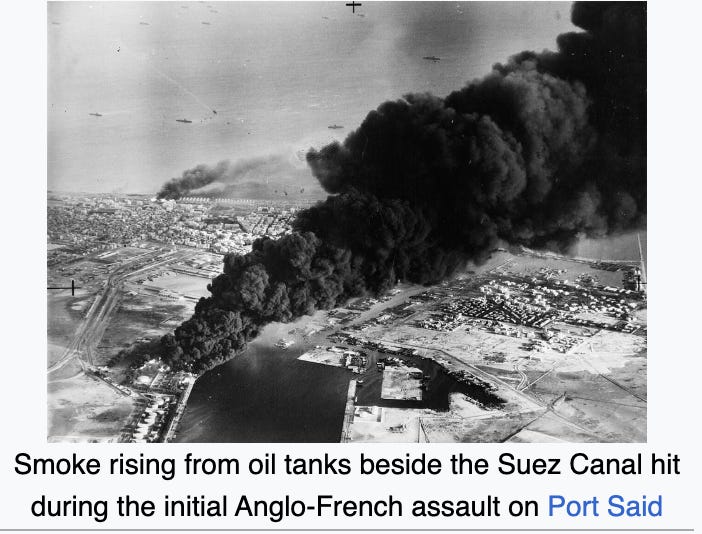
Smoke rising from oil tanks beside the Suez Canal hit during the initial Anglo-French assault on Port Said
Is the U.S. Facing a Suez Crisis Moment?
The current situation in the Strait of Hormuz is reminiscent of the UK's Suez Crisis of 1956
Students of British imperial history are intimately familiar with the Suez Crisis of October–November 1956. The crisis began when Egyptian President Gamal Nasser nationalized the Suez Canal on July 26, 1956, taking control of it from the British and French Suez Canal Company.
Britain and France then secretly coordinated with Israel, which sought to end Egyptian blockade of Israeli shipping. On October 29, Israel invaded the Sinai; Britain and France issued an ultimatum and then launched air and naval attacks to seize the canal under the pretext of serving as “peacekeepers.”
The United States and the Soviet Union pressured Britain, France, and Israel to cease hostilities, and the invading forces withdrew in early 1957. The crisis marked a sharp decline in British and French global influence.
In retrospect, it seems that British Prime Minster, Anthony Eden made a number of miscalculations. President Eisenhower was very unhappy when he discovered that Britain had secretly plotted with Israel and France. The perception of Britain as a covert schemer wrecked its moral standing and caused many observers to regard the British and French military actions NOT as “a peace keeping operation” but as an unprovoked invasion.
British leadership characterized Nasser as a “Hitler-like” dictator who could be easily toppled, failing to recognize that the experience of being attacked would produce a feeling of solidarity in Egypt for their leader, as flawed as he was.
British leaders also failed to recognize Britain’s economic vulnerability arising from its dependence on the the United States, which could use its financial leverage to force the British to retreat.
Is the United States now facing a Suez Crisis moment? Every imperial power ultimately discovered the limits of its power, to the surprise many who believed that their empire was inherently different from the empires of the past.
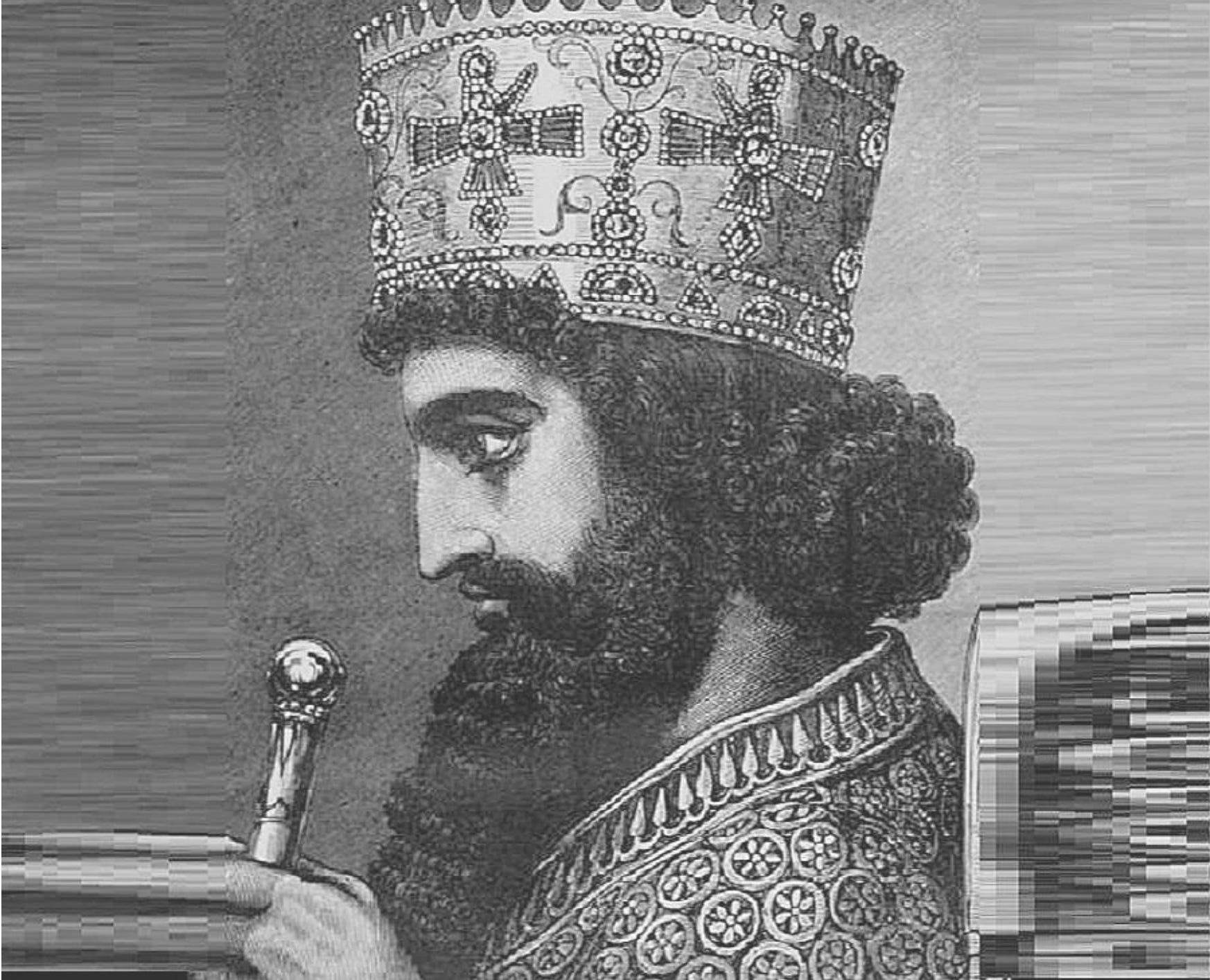
In recent weeks I have often been reminded of the Persian King Xerxes I. After years of expanding the Persian Empire to the West from its ancient seat in present day Iran, Xerxes invaded mainland Greece in 480 BC. The Greek historian Herodotus wrote a vivid and detailed account of the battles that followed. Many historians consider Herodotus’s The Histories the first great work of history in western literature.
Herodotus characterized Xerxes I as an arrogant, emotionally volatile, and hubristic commander who allowed his ambitions to cloud his reason. With no clear strategy or even serious appraisal of the Greek resistance he would face, he was inclined to petulant bouts of rage and a tendency to be swayed by advisors who told him what he wanted to hear.
His failure to respect his enemy resulted in a memorably embarrassing moment when he laughed at the King Leonidas when it became clear that the Spartan commander was going to try to hold his ground at the Thermopylae pass instead of ceding it to the vastly larger Persian army.
Above all, Xerxes failed to appreciate that—despite their own fractiousness—the Greeks would be motivated to defend their homeland and would make good tactical use of their mountainous terrain and narrow waterways.
https://www.thefocalpoints.com/p/dr-mccullough-drops-the-hammer-in
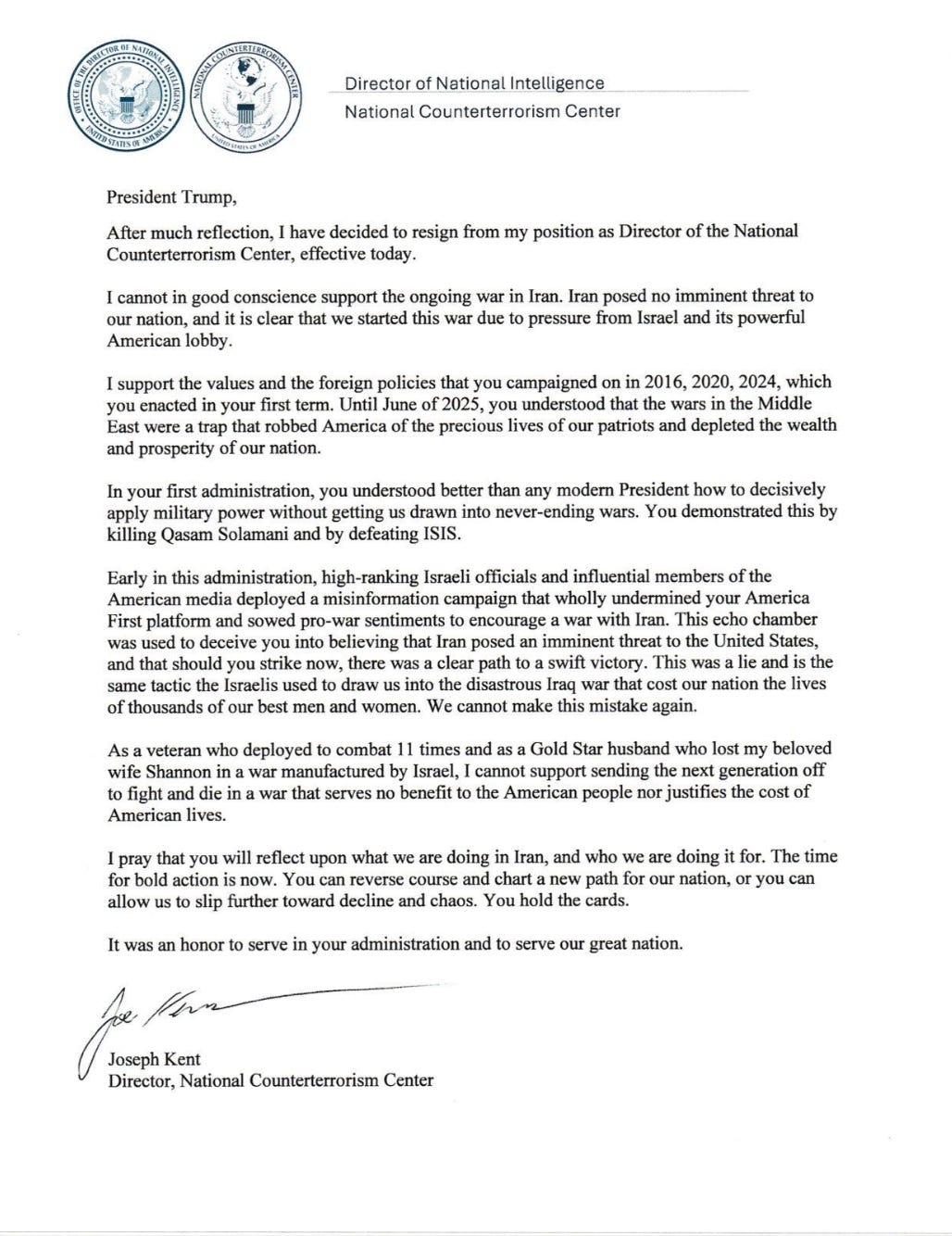
Head of the National Counterterrorism Center Resigns to protest the war on Iran
Humanity United Now - Ana Maria Mihalcea, MD, PhD cross-posted a post from Meryl’s CHAOS letter (Critical Health Analysis and OpinionS

Ana Maria Mihalcea, MD, PhDMar 17 · Humanity United Now - Ana Maria Mihalcea, MD, PhD
So sad, the great people who have not sold their souls to Israel are leaving. It is such a loss to the future of America to see this detrimental change of heart in our Administration. From the love of peace to the love of war. Our hopes for freedom and justice are blown up in smoke - for what? Greed, power, and another nations directive
Many thanks to John Leake. Unable to crosspost, so please go to his site.
Meryl Nass May 17th
Joe Kent, director of the National Counterterrorism Center, just resigned, stating his reasons in the following letter…
Joe Kent, director of the National Counterterrorism Center, just resigned, stating his reasons in the following letter.
Counterterrorism Director Joe Kent Resigns
“I cannot in good conscience support the ongoing war in Iran"
True Crime Writer. Coauthor with Dr. Peter McCullough of "The Courage to Face COVID-19.: Preventing Hospitalization and Death While Battling the Biopharmaceutical Complex.
The Head of the Mossad: In Pursuit of a Safe and Secure Israel. By Shabtai Shavit. Notre Dame, IN: University of Notre Dame Press, 2020. ISBN 9780268108335. Hardcover. 434 Pages. $29.00
https://www.academia.edu/94000982/The
Head_of_the_Mossad_In_Pursuit_
of_a_Safe_and_Secure_Israel_
By_Shabtai_Shavit_Notre_Dame_
IN_University_of_Notre_Dame_
Press_2020_ISBN_9780268108335_
Hardcover_434_Pages_29_00?
email_work_card=reading-
history
The Head of the Mossad: In Pursuit of a Safe and Secure Israel. By Shabtai Shavit. Notre Dame, IN: University of Notre Dame Press, 2020. ISBN 9780268108335. Hardcover. 434 Pages. $29.00
The_Head_of_the_Mossad_In_Pursuit_of_a_Safe_and_Secure_Israel_By_Shabtai_Shavit_Notre_Dame_IN_University_of_Notre_Dame_Press_2020_ISBN_9780268108335_Hardcover_434_Pages_29_00
The Head of the Mossad: In Pursuit of a Safe and Secure Israel. By Shabtai Shavit. Notre Dame, IN: University of Notre Dame Press, 2020. ISBN 9780268108335. Hardcover. 434 Pages. $29.00
Journal of Strategic Security Journal of Strategic Security Volume 14 Number 1 Article 9 The Head of the Mossad: In Pursuit of a Safe and Secure Israel. The Head of the Mossad: In Pursuit of a Safe and Secure Israel. By Shabtai Shavit. Notre Dame, IN: University of Notre Dame By Shabtai Shavit. Notre Dame, IN: University of Notre Dame Press, 2020. ISBN 9780268108335. Hardcover. 434 Pages. Press, 2020. ISBN 9780268108335. Hardcover. 434 Pages. $29.00. $29.00. Nadav Morag Sam Houston State University,
This email address is being protected from spambots. You need JavaScript enabled to view it. Follow this and additional works at:
https://digitalcommons.usf.edu/jss pp. 125-128 Recommended Citation Morag, Nadav. "The Head of the Mossad: In Pursuit of a Safe and Secure Israel. By Shabtai Shavit. Notre Dame, IN: University of Notre Dame Press, 2020. ISBN 9780268108335. Hardcover. 434 Pages. $29.00.." Journal of Strategic Security 14, no. 1 (2021) : 125-128. DOI:
https://doi.org/10.5038/1944-0472.14.1.1926 Available at:
https://digitalcommons.usf.edu/jss/vol14/iss1/9 This Book Review is brought to you for free and open access by the Open Access Journals at Digital Commons @ University of South Florida. It has been accepted for inclusion in Journal of Strategic Security by an authorized editor of Digital Commons @ University of South Florida. For more information, please contact
This email address is being protected from spambots. You need JavaScript enabled to view it..
The Head of the Mossad: In Pursuit of a Safe and Secure Israel. By Shabtai Shavit. Notre Dame, IN: University of Notre Dame Press, 2020. ISBN 9780268108335. Hardcover. 434 Pages. $29.00. This book review is available in Journal of Strategic Security:
https://digitalcommons.usf.edu/jss/ vol14/iss1/9
125 The Head of the Mossad: In Pursuit of a Safe and Secure Israel. By Shabtai Shavit. Notre Dame, IN: University of Notre Dame Press, 2020. ISBN 9780268108335. Hardcover. 434 Pages. $29.00. Reviewed by Nadav Morag, Sam Houston State University This book consists of the views of Shabtai Shavit, who served as the head of Israel’s civilian external intelligence agency, Ha Mossad le Modi’in ve Tafkidim Meuchadim (the institute for intelligence and special duties), more commonly known as the Mossad (institute). Shavit served as head of the Mossad between 1989 and 1996, an eventful period in Israel’s history (though one would be hard-pressed to find any period in Israeli history that was not eventful) that included the end of the Cold War, peace negotiations with the Palestinians and the establishment of the Palestinian Authority, the debut of Palestinian suicide bombing attacks in Israel, and the first Gulf War. Consequently, there is undoubtedly a great deal of interesting information and a range of insights that Shavit could convey on how these momentous events affected Israel and how Israel responded to them, at least within the context of the Mossad’s role. A book written by a former Mossad head could be an extremely valuable addition to the literature, not only on this covert Israeli agency, but on the manner in which intelligence impacts decision-making in Israel. Such a book could also provide insights into the nature of intelligence cooperation between Israeli intelligence and security agencies and between the Mossad and foreign intelligence agencies. Furthermore, such a book could contribute to the understanding of the Mossad’s role as Israel’s “secret foreign ministry” with respect to countries that do not have diplomatic relations with Israel (particularly those that are technically enemies of the State of Israel). The problem with Shavit’s book is that it does none of this. Of course, this type of information is heavily classified and therefore he is not at liberty to disclose any of this, but, herein lies the rub: Many thoughtful works by scholars (including those with intelligence experience) and good journalists have been written on the Mossad (Melman and Raviv), on the nature of intelligence (Lowenthal, Laquer, Wirtz, Dahl), and on Israel’s covert relationships with various countries (Ben-Zvi, Posner, Jones), etc., and thus the added value of a book by a former Mossad head lies in his experiences and insights with respect to sensitive matters he was directly involved with, and yet it is precisely these matters that he cannot disclose. Instead, Shavit offers us a broad range of his opinions on various issues relating to intelligence, the Arab-Israeli conflict, national security, diplomacy, world events, terrorism, and others. To be fair, Shavit does not claim that he has produced a scholarly work and he notes that his book “…does not purport to present scientific research; rather, it conveys the author’s personal opinions” (p. xix). But it is not clear what the value is of his personal opinions if he cannot demonstrate their validity through his actual experiences and it is therefore unclear as to what led him to take certain positions on certain issues. The literature on intelligence, the Arab- Israeli conflict, national security, covert diplomacy, and related issues is rich and varied and there is a plethora of scholarly books, articles, and think tank publications, properly footnoted, that address the issues covered in Shavit’s book in clearer and more comprehensive ways, with evidence provided for assertions made. It is true that Shavit held a very senior role and that he was in a position to observe, and possibly to influence, policy making at the Prime Ministerial level, but his views on Israel’s national security and fundamental interests, at least as expressed in this book, are not unique or particularly insightful. The fundamental interests of a given country (or at least one that is widely known and therefore holds interest for scholars, analysts, and journalists) can be discerned by anyone with the time and patience to do some reading. There is no magic insight afforded by access to intelligence or other classified information when one is focused on larger strategic issues (as opposed to tactical intelligence, which can be incredibly valuable). In the United States alone, there are over one hundred think tanks and universities that produce high-quality scholarship and analysis on national interests, challenges, domestic political considerations, military capabilities, economic and social issues, etc. relating to many countries, Israel included. Shavit recognized the value of this type of strategic analysis in his establishment of the Mossad’s Research Department, thus, as he notes, transforming the Mossad from “…an intelligence-gathering and special operations agency to an intelligence-gathering, special operations, and research and assessment agency…” (p. 6). However, when he describes some of the conclusions reached by this department, or by a team he established in 1995 (known as Forum 2000) in order to assess threats and opportunities for Israel in the new century, those conclusions are no different, and in many cases less sophisticated, than those that can be found in the better assessments by think tanks and scholars. For example, recommendations for fighting Jihadi terrorism include: “improving intelligence gathering, better technology for sampling airborne agents, tracking the flow of terrorist funds, increasing cyber capabilities, use of intelligence to build criminal cases, enhancing intelligence cooperation between national agencies, and integrating intelligence into combat operations” (pp. 81-82). There is nothing new or particularly insightful in this list of proposed measures. Similarly, when considering the potential impact of an Israeli attack on Iran, Shavit provides a series of issues for Israeli policymakers to consider such as: Whether Hezbollah will respond to an attack on Iran by Israel, when the United States should be informed of an imminent attack on Iran, whether Israel should target only Iran’s nuclear sites, or try to disrupt the government by attacking government targets, and whether it might be possible to attack Iran in such a way that allows plausible deniability (p. 121). Nothing here is new or absent from a range of analytical works on this issue (including, for example, analysis by Anthony Cordesman of the Center for Strategic and International Studies). Nevertheless, had Shavit’s work distilled much of this into one organized and well-substantiated volume, this would have provided a useful service to those less familiar with these issues. However, Shavit’s objective was to provide his opinions on various issues, not to create a primer on intelligence, national security, the Arab-Israeli conflict, covert diplomacy, or other such issues. Moreover, the book meanders from topic to topic without any clear attempt to build on information from previous sections in order to draw conclusions. For example, on one page, the author discusses the relationship between the Mossad and Israeli law enforcement and in the next few pages, the author moves on to discussing the Iranian threat to Israel. There appears to be little organizational logic in the manner in which topics are introduced and addressed. In summary, there can be little doubt that Shabtai Shavit possesses a wealth of experience and insight by virtue of his former key role in the Israeli intelligence system. At the same time, he is legally and morally bound not to divulge national security secrets and thus cannot share these experiences and insights. Given these constraints, and given his apparent lack of desire to create a work of evidence-based research (something that he presumably would have expected from the Mossad’s Research Department when he headed the agency), he has produced instead a book of opinions. There may be, perhaps, some residual value in reading the opinions of a former head of the Mossad as it may demonstrate the thinking of some in the Israeli security community during a particular historical period, but I can think of better ways to educate oneself on the issues addressed in this book. Journal of Strategic Security, Vol. 14, No. 1
https://digitalcommons.usf.edu/jss/vol14/iss1/9 DOI:
https://doi.org/10.5038/1944-0472.14.1.1926
Morag: The Head of the Mossad: In Pursuit of a Safe and Secure Israel Produced by The Berkeley Electronic Press, 2021
Morag:
The Head of the Mossad: In Pursuit of a Safe and Secure Israel Produced by The Berkeley Electronic Press, 2021
https://www.academia.edu/116787395/_Profiles_in_Intelligence_An_Interview_with_8th_Mossad_Chief_Danny_Yatom_Intelligence_and_National_Security_27_no_7_2024_1121_1135?email_work_card=reading-history
Intelligence and National Security ISSN: (Print) (Online) Journal homepage:
www.tandfonline.com/journals/fi
nt20 ‘Profiles in intelligence’: an interview with 8th Mossad chief Danny Yatom Eldad Ben Aharon To cite this article: Eldad Ben Aharon (2024) ‘Profiles in intelligence’: an interview with 8th Mossad chief Danny Yatom, Intelligence and National Security, 39:7, 1121-1135, DOI: 10.1080/02684527.2024.2332030 To link to this article:
https://doi.org/10.1080/02684527.2024.2332030Intelligence and National Security ISSN: (Print) (Online) Journal homepage: www.tandfonline.com/journals/fint20 ‘Profiles in intelligence’: an interview with 8th Mossad chief Danny Yatom Eldad Ben Aharon To cite this article: Eldad Ben Aharon (2024) ‘Profiles in intelligence’: an interview with 8th Mossad chief Danny Yatom, Intelligence and National Security, 39:7, 1121-1135, DOI: 10.1080/02684527.2024.2332030 To link to this article: https://doi.org/10.1080/02684527.2024.2332030 © 2024 Informa UK Limited, trading as Taylor & Francis Group Published online: 27 Mar 2024. Submit your article to this journal Article views: 3770 View related articles View Crossmark data Citing articles: 1 View citing articles Full Terms & Conditions of access and use can be found at https://www.tandfonline.com/action/journalInformation?journalCode=fint20
‘Profiles in intelligence’: an interview with 8th Mossad chief Danny Yatom Eldad Ben Aharon ABSTRACT This article is based on an interview conducted in July 2023 with Danny Yatom, the eighth Mossad chief. He had a distinguished career in the Israeli Defense Force, joining the Mossad in 1996 after his military service. Yatom’s contributions were pivotal during the 1980s and 1990s, particu- larly in diplomatic engagements and peace negotiations between Israel and Jordan. With experience spanning elite military units, intelligence agencies, Prime Minister’s offices, and the Israeli Parliament, his insights offer a comprehensive understanding of intricate matters, making it the primary reason for my decision to interview Yatom. Among other topics, Yatom provided nuanced perspectives on Israel’s involvement in the Nagorno-Karabakh conflict, its relations with Azerbaijan, the special ties between Israel and Germany, and the 1979 Islamic revolution. I also inquired about the impact of emotions on decision-making in national security, the historical trajectory of the Mossad, and Israel’s approach to Official Public Intelligence Disclosure. ARTICLE HISTORY Received 23 February 2024 Accepted 12 March 2024 KEYWORDS Mossad; elite interviews; Danny Yatom; Israel’s intelligence history; official public intelligence disclosure Introduction Danny Yatom was born on 15 March 1945. He served as the eighth Mossad chief, from 1996 to 1998. Before joining the Mossad in 1996, Yatom had a distinguished career in the Israeli Defense Force (IDF) as a Major General (Ret.), specializing in special forces and earning a Medal of Bravery during his service. Over his 30-year career in the IDF, Yatom held various significant positions within the Israeli security forces and the intelligence community. 1 He also served as the head of the IDF’s Planning Directorate, and military secretary to Defense Ministers Moshe Arens and to Prime Ministers (PM) Yitzhak Rabin and Shimon Peres. 2 During the 1980s and 1990s, Yatom played a pivotal role in the Israeli military and intelligence community. Furthermore, he played a significant role in diplomatic initiatives and peace talks between Israel and the Palestinians, and in the signing of the peace agreement with Jordan in 1994. Yatom has published a thorough autobiography in both Hebrew and English. 3 His auto- biography delves into his extensive military and intelligence career, with a particular focus on significant moments of the 1990s, including peace negotiations and the initial waves of Hamas terrorist attacks. Yatom’s autobiography highlights important milestones as well as moments of failure. 4 His is profound understanding of Israel’s intelligence and national security realms stems from Yatom’s broad and varied background. He is part of an esteemed group of Israeli elite who have held positions in military units, intelligence agencies, PM’s offices, and the Israeli Parliament. This viewpoint provides a comprehensive understanding that enhances our grasp of these intricate matters, making it the primary reason for my decision to interview Yatom. CONTACT Eldad Ben Aharon This email address is being protected from spambots. You need JavaScript enabled to view it. INTELLIGENCE AND NATIONAL SECURITY 2024, VOL. 39, NO. 7, 1121–1135 https://doi.org/10.1080/02684527.2024.2332030
Interview context
This interview took place in Herzliya Pitu’ah, Israel, during the scorching summer of 2023. Since January 2023, Israeli society and the political landscape have become significantly polarized follow- ing the initiative by PM Benjamin Netanyahu and Minister of Justice Yariv Levin, who introduced a contested legislative package aimed at reshaping the judicial system. 5 While tension lingered, few anticipated that Israel would face a significantly graver crisis after the Hamas surprise attack on 7 October 2023. 6 This attack led to significant casualties: more than 1,400 Israelis were killed, with thousands more injured, more than 230 Israeli men, women, and children were taken hostage. 7 As of writing these lines (February 2024), the Israeli operation ‘Swords of Iron’ in Gaza remains ongoing, with no indication of a ceasefire in sight. As the conflict persists, it has prompted extensive interna- tional condemnation of Israel’s actions in the Gaza war. Accusations of civilian deaths and allegations of genocide and war crimes by Israel against Palestinians have been widely raised. On 29 December 2023, South Africa petitioned the International Court of Justice (ICJ) to investigate whether Israel is committing genocide against Palestinians in Gaza. 8 On 16 February 2023, the ICJ partially dismissed allegations of genocide and issued provisional measures. Nevertheless, the vigorous public and academic debate concerning the question of genocide and mass violence in the Gaza War continues. 9 The intelligence debacle on 7 October 2023, occurring 50 years after the failure during the Yom Kippur War, appears to be Israel’s most severe since its establishment in 1948. 10 Extensive research has been published about the failure of Israeli intelligence in the Yom Kippur War in 1973, some of it recently here in Intelligence and National Security (INS). 11 To be sure, the failure in October 2023 is bound to attract much more attention in future research. It also necessitates a series of interviews with individuals like Yatom and others, solely focused on analyzing the intelligence and military failure. Two main limitations impacted the interview with Yatom. Clearly, discussing the intelligence failure of 7th October during that time was not feasible because the interview with Yatom had taken place three months earlier. Also, as the interview was limited to one hour, I did not want to squander valuable time with Yatom by asking about matters that can be thoroughly explored in his auto- biography or not directly related to my research projects. The interview with Yatom further contributes to the oral history project that I have been leading since 2015, with specific segments previously featured in INS. 12 This interview primarily focused on Israel’s foreign policy, intelligence history, and national security. These topics are intricately intertwined with several ongoing research projects I have recently undertaken, Israel’s role in the Nagorno-Karabakh (NK) conflict, Israel’s relations with Azerbaijan, the special ties between Israel and Germany, and the 1979 Islamic revolution. 13 Additional questions directed at Yatom delved into current significant debates within the realms of intelligence and national security. One such topic explored the intersection of national security and democracy. For example, Yatom’s unique position as the first Mossad chief whose identity was revealed upon appointment sparked interest in understanding how this aspect influenced his role. Also, I explored Yatom’s viewpoints on Israel’s strategy regarding Official Public Intelligence Disclosure (OPID), often referred to as the ‘disclosure dilemma’. 14 I inquired about his first hand experiences with competition among Israeli security institutions and the diplomatic apparatus concerning influence and decision-making. 15 Additionally, Yatom shared his insights on the role of emotions in decision-making within the realm of national security and intelligence, along with discussing the history of Mossad. As shown in the image accompanying the interview text below, it took place in Yatom’s office. When interviewing the Israeli intelligence elite, I find the office space of the interview subject to be the most suitable venue. 16 The office space serves as their professional environment, adorned with symbols of their career such as flags, professional photos, and books. This 1122 E. BEN AHARON
physical setting helps the interviewee feel comfortable and in control, facilitating the sharing of accounts and memories. This environment is crucial for establishing trust and maintaining a professional tone during the interview process. Dr. Eldad Ben-Aharon (left) interviewing the 8th Mossad chief, Danny Yatom (right), in Herzliya Pitu’ah, Israel, on 19 July 2023. Interview 17 Eldad Ben-Aharon (EBA): A question you may already have answered on innumerable occasions, but can you tell me what made decide on a career in state security and intelligence? What made you decide this was your calling? Danny Yatom (DY): I was born in 1945, before the establishment of the State of Israel (1948). The atmosphere at home was very different from what it is today. You know, those who didn’t live then can’t really understand what that entailed. There was an atmosphere of friendship, camaraderie, and concern for one another. We lived a very simple life, but we knew we had to contribute to the development, success, and security of the State of Israel. We were exposed to all sorts of things related to security, through classes like Shelah 18 and Gadna. 19 In the early years, the country was small, within the [pre-]1967 borders, and there were countless security incidents. Security was always in the headlines and at the top of the agenda. It was therefore absolutely clear to me, from an early age, that I would volunteer for the paratroopers. We had no idea of the existence of Sayeret Matkal. (SM). 20 The unit was just a rumor, from mouth to ear. Really. It was made up of moshav and kibbutz members, and I was nothing like that; I was a city kid from Netanya. The reprisals carried out by the paratroopers fired up my imagination. It was just so clear to me that I would enlist in a combat unit, preferably the paratroopers. Because this was the atmosphere, it’s hardly surprising that not only I but many members of my generation felt the same, intuited the same thing. The result was that, without having put together any kind of strategy whatsoever and only because I ended up in SM – the kinds of things we did there, the people I met, and the fact that at if you’re a commander at such a young age you get tasked with missions beyond enemy lines, without going into any details – all of these tremendously boosted my maturity. This made me decide that this would be the direction of my career, that this was something I wanted to continue considering. And every year, I signed on for ‘just another year’ in the standing army. No more than that, so that I’d always have the option of leaving and entering civilian life. The way I was raised and the atmosphere around me tilted the INTELLIGENCE AND NATIONAL SECURITY 1123
physical setting helps the interviewee feel comfortable and in control, facilitating the sharing of accounts and memories. This environment is crucial for establishing trust and maintaining a professional tone during the interview process. Dr. Eldad Ben-Aharon (left) interviewing the 8th Mossad chief, Danny Yatom (right), in Herzliya Pitu’ah, Israel, on 19 July 2023. Interview 17 Eldad Ben-Aharon (EBA): A question you may already have answered on innumerable occasions, but can you tell me what made decide on a career in state security and intelligence? What made you decide this was your calling? Danny Yatom (DY): I was born in 1945, before the establishment of the State of Israel (1948). The atmosphere at home was very different from what it is today. You know, those who didn’t live then can’t really understand what that entailed. There was an atmosphere of friendship, camaraderie, and concern for one another. We lived a very simple life, but we knew we had to contribute to the development, success, and security of the State of Israel. We were exposed to all sorts of things related to security, through classes like Shelah 18 and Gadna. 19 In the early years, the country was small, within the [pre-]1967 borders, and there were countless security incidents. Security was always in the headlines and at the top of the agenda. It was therefore absolutely clear to me, from an early age, that I would volunteer for the paratroopers. We had no idea of the existence of Sayeret Matkal. (SM). 20 The unit was just a rumor, from mouth to ear. Really. It was made up of moshav and kibbutz members, and I was nothing like that; I was a city kid from Netanya. The reprisals carried out by the paratroopers fired up my imagination. It was just so clear to me that I would enlist in a combat unit, preferably the paratroopers. Because this was the atmosphere, it’s hardly surprising that not only I but many members of my generation felt the same, intuited the same thing. The result was that, without having put together any kind of strategy whatsoever and only because I ended up in SM – the kinds of things we did there, the people I met, and the fact that at if you’re a commander at such a young age you get tasked with missions beyond enemy lines, without going into any details – all of these tremendously boosted my maturity. This made me decide that this would be the direction of my career, that this was something I wanted to continue considering. And every year, I signed on for ‘just another year’ in the standing army. No more than that, so that I’d always have the option of leaving and entering civilian life. The way I was raised and the atmosphere around me tilted the INTELLIGENCE AND NATIONAL SECURITY 1123
scales. I remember how, at home, I was always told, ‘But Ben-Gurion said . . . ’ so therefore you had to obey. 21 This is also the main reason that my siblings and I and all live in Israel and we all spent our careers working in the field of security. But this didn’t transmit to the next generation. And I never tried to convince anyone. Everyone chooses their own path. EBA: As someone who commanded the Mossad, can you sketch out the organization’s history? DY: Look, I think it’s very difficult to summarize it in a few sentences while also diving into any detail. I was familiar with the Mossad since the time I served as military secretary. The function of a military secretary is to be the link that connects the Mossad chief and the PM. I was appointed to serve as then-Defense Minister Moshe Arens’s military secretary in 1983. This was the first time I got to know the Mossad and this ‘getting-acquainted’ period lasted more than two years. The second time was when I ended my term as General Commanding Officer of the Central Command and Yitzhak Rabin asked me to become military secretary again. That’s how I got to know the Mossad. But it was only after I became Mossad chief and became part of it and got really and truly involved in the organization that I realized how much of it I was not familiar with and how much I didn’t yet know. So, to get back to your question: it’s a versatile organization with a lot of diverse capabilities with the intelligence to view things outside the box. The Mossad constantly teaches you to look for the unusual, for the non-standard. The people there are just fantastic. Their daring and ability to see the whole picture, as well as their persistence and single-mindedness and the courage they must demonstrate, day in day out, are extraordinary. Bottom line – since its establishment, the Mossad has been a rare jewel in the human landscape of the people and State of Israel, despite the mishaps, because there will always be mishaps. The human capital is this organization’s central quality. EBA: You were the first Mossad chief whose name was declassified and made available to the media, thereby demystifying the Mossad to a certain extent. What were your feelings about that? DY: Look, then-PM Yitzhak Rabin realized that he had no choice because the Supreme Court was going to rule contrary to his position, which was not to identify the Shin Bet and Mossad chiefs. Till then, the custom was that the identities of the security establishment leaders who got the jobs were made public only once they ended their tenure. I got to witness the whole process, the attempt to keep the Supreme Court’s pressure at bay. In the end, then-Attorney General Michael Ben-Yair (1993- 1997) came to Rabin and told him, ‘Look, Mr. PM, we’re going to lose to battle. We’ve run out of arguments’. Rabin decided to go along with this. It meant contacting one of the newspapers to publicize my identity. I have to tell you that when I served as Mossad chief, the fact that my identity was known to the public bothered me a great deal, especially when operating abroad. Every time I oversaw activity abroad, I had to get into costume. I had to make sure no one could identify me. But, look, that’s democracy. Even before I became Mossad chief, my identity was known. I was identified publicly; I was Rabin’s military secretary the entire period of the very intensive peace process. So that, in any case, I was hardly an anonymous figure in Israel. EBA: As we are already delving into the realm of national security and democracy, 22 to your way of thinking and based on your experience, can an Member of Parliament (MP) affect national security 1124 E. BEN AHARON
decision making? 23 To what extent did you experience a sense of parliamentary paralysis 24 when you served as an MP, specifically in the context of national security-related matters? i.e., that the Israeli Parliament (the Knesset) is incapable of carrying out its function of supervising the government and the security establishment. DY: The Knesset is a weak body and wields almost no influence. It’s as if it’s welded to the government, because the Knesset elects the government. The majority in the Knesset is also the majority in the government, so that they are a single entity. In Israel’s parliamentary democracy, there’s supposed to be a balance among three branches: the judiciary, which exerts judicial review of the executive branch and also the Knesset, because the legislative branch has no independent capacity to perform any kind of matter-of-fact oversight of the government. For example, right now, we have a situation in which Itamar Ben-Gvir, the national security minister, wants to control administrative detentions. 25 Ben-Gvir presents this as him being able to issue administrative deten- tions with regard to crime in Israeli Arab society. But because this might become completely arbitrary, it’s a slippery slope, and tomorrow he could decide to order anyone he doesn’t care for held under administrative detention. And, in this case, it makes absolutely no difference what the Knesset – as the body charged with oversight of the government on security issues – thinks. I’m also convinced that, at present, there are coalition MKs who understand that the judicial upheaval is a bad thing, but they don’t dare open their mouths because they’re worried about future jobs. They don’t want to oppose the sitting government because there’s no way they’ll get a cushy position in the future. Also, the Knesset cannot function as a counterweight to anything. The political culture and the considerations in the Knesset are entirely particularistic: for the good of a certain party, individual, or group. Not for the good of all, only for the good of particular sectors. The function of the Knesset is to pass laws and critique the work of the government. When it comes to legislation, even if there’s a good law – if the government doesn’t want it, it won’t pass. EBA: There is much academic, policy and public discussion surrounding the hostility between Israel and a nuclear Iran. 26 The enmity also makes it clear that, from the Iranian perspective, it’s necessary to destroy Israel and its Zionist identity, reflecting a hatred towards Judaism and everything it represents. 27 Can you go back a bit to the 1970s and the time when Israel still had relatively good relations with Iran under the Shah? As a formative moment in the Cold War, how did Israel’s security establishment experience the deterioration and fall of the Shah and Iran’s revolution in 1979? DY: Back then, I wasn’t involved in, or connected to, the relationship between Israel and Iran. Of course, I remember the stories told by the late Uri Lubrani, Israel’s last ambassador to Iran before the 1979 revolution, and others who managed to escape by the skin of their teeth before Khomeini took over. But when I came to the Mossad, and earlier, as Rabin’s military secretary, I had already dealt with the matter; because I will never forget that Rabin, whenever he met a world leader – a president or PM or the like – would always say, ‘It is imperative to prevent Iran from becoming a nuclear power, because the moment Iran has the bomb, we’ll never be able to sign peace agreements with the Muslim nations, because Iran will threaten them. So, we have a window of opportunity to try to keep Iran from becoming nuclear’. I remember the time of the revolution, but in 1979, I had no real connection to the matter, and I wasn’t privy to intelligence. At first, I wasn’t worried. And then, slowly but surely this monster developed into becoming what is now the central threat to Israel. Then, nuclear bombs weren’t under discussion because Ayatollah Khomeini would in no way agree to any nuclear development, even though the Shah, his predecessor as Iran’s leader, had had such notions. It took time until this stance changed. As Mossad chief, I dealt with the matter to a highly significant degree. In general, the Mossad has two major missions: one, to keep enemy and hostile nations from arming themselves with unconventional weapons – chemical, biological, and atomic; and the second mission – to wage war on terrorism across the length and breadth of the globe. These are the two key missions and they informed me as well. Therefore, even back then, efforts and methods and so on were invested into derailing Iran’s attempts. Even then, Iran had a habit of engaging in all sorts of tricks, founding all sorts of straw companies and deceiving the whole world. And Iran has remained a large part of our activity to this day. EBA: How did the relationship with Iran, which collapsed in 1979, change the geopolitical distribu- tion of power in the Middle East vis-à-vis the Cold War? 28 And the importance of Turkey – another huge Muslim nation in the region – for Israel? DY: Back then, Israel’s foreign policy was built on the circles theory, meaning construct a circle that surrounds your enemy with nations that are friendly towards you in order to hem the enemy in and prevent the enemy from harming you. 29 That was and is the policy in place to date at the Ministry of Foreign Affairs (MFA) and other institutions. So, absent the two major components in the external circle (Iran and Turkey). The farther nations were more distant in Africa, especially the special relations with South Africa, which flourished at that time. To get out of that crisis, the direction was towards friendly nations in Europe and the Far East. Moreover, the United States was always our pillar of support ever since France abandoned that position in the early 1960s. Israel always built itself as part of coalitions surrounding the threat. You have to look for the rationale when you’re looking at the map and see Lebanon, Syria, Jordan, and Egypt surrounding us. Now, look for the countries surrounding the countries surrounding us. Other than this strategy, there was a much more comprehensive strategy: be friends with anyone who wants to and can be your friend. And the more friends you have in the world, the better your national security. Furthermore, in 1979, the peace treaty with Egypt was one of the important components of Iran and Turkey’s replacement. The peace agreement came into being at almost the same time. To a certain degree, the peace balances the fact that the Iranian factor was gone and that relations with Turkey were in flux. But there was peace with Egypt, so it was possible to start building something there. Afterwards came the improvement in the relationship with Morocco and other North African countries, which was still a secret and which the Mossad spearheaded. That was the solution. In the absence of the foundation with Iran, which had collapsed, you looked for replacements even if they weren’t of the same order, even if they weren’t as strong. But they were better than nothing. EBA: The 2010 flotilla incident 30 – how did it affect Israel’s security approach? and the how a nation (Turkey), perceived as friendly with formal diplomatic ties, challenges Israeli borders and national security with such a provocation? DY: There is no doubt that, at least to my understanding, it makes sense to prepare emergency plans for a time when something like that happens, because then you’re really caught in a dilemma. Behind that flotilla, there was a state that was also saying ‘If you irritate the Palestinians in Gaza, I will dispatch warships’. I remember Erdoğan saying this. 31 The way to handle it is, first of all, by building capacities to stop and cope even with a nation that wasn’t considered to be an enemy from a security perspective. To my own thinking, we wouldn’t have reached a breakdown [in relations] with Turkey at that time. 32 The flotilla was mainly an attempt to scare us into thinking that the Turkish navy would sail in the wake of the civilian flotilla. And that wouldn’t have happened, in my
opinion. At that time, Turkey was not motivated to burn its bridges with Israel to the point of a clash
between the respective armies. That wasn’t the intention. Absolutely not, given that Erdoğan kept jumping from policy X to policy Y each time anew. He found himself at odds with Egypt as a result of what happened in Gaza and the question of assuming responsibility for Gaza instead of the Egyptians, and so on. And that’s happening now as well (July 2023). Suddenly, Erdoğan eases relations between Israel and Turkey and supports them and then he suddenly gets in their way. Beyond the fact that Israel has to be prepared for scenarios of that sort, it isn’t necessary to construct a new army or turn the Israeli Navy into something altogether different. But it is necessary that have such plans, for example, to seize control of the Marmara in 2010. Several tactical errors were made as a result of which members of Shayetet 13 were caught by people who beat them up and one was wounded and so on. 33 The episode should have ended very differently. But that was our bad conduct and therefore it also became a balloon that blew up in our face. The other, more influential factor is the political side. It is crucial to make sure that, the moment there are signs of something like this happening, all of Europe and the United States and all democracies be prepared to come down hard on Turkey. Those nations must have a uniform response because one of these days it might happen to them too. EBA: You held several positions in the security establishment: military secretary, Mossad chief, head of former PM Ehud Barak’s political-security staff. Can you describe the tensions among these institutions? One often has the sense that there is real competition between the security institutions and the diplomatic system over influence and decision making. Obviously, it changes from one PM to another, but, still, there’s a sense that there is intense competition over influence on political and security matters. DY: First of all, the situation today is much better than it was when I was either military secretary or Mossad chief. Throughout the years, there’s been not just tension but actual hostility among some of the institutions. I’m mostly referring here to the intelligence and security institutions: Military Intelligence, the Shin Bet, the Mossad, and today there’s also the National Security Council. 34 And the MFA, which was always running to catch up but never had any clout. I remember quite a number of incidents where personal jealousy and hostility and someone’s desire to guard his own fiefdom actually damaged what was supposed to be cooperative or complementary work among the different institutions. There were many attempts to set a sort of ‘Magna Carta’ down in writing to delineate the ‘territory’ of each of the intel agencies. At the end of the day, it depends on the personalities of the people heading these organizations, which is why I say that today the situation is much better. Even in my time, the situation had improved compared to what it had been earlier – without mentioning any names – when the Mossad chief wasn’t even on speaking terms with the head of AMAN. 35 It was that bad. Nowadays there’s much greater openness. There’s a sort of ‘bucket’ where everyone ‘tosses’ the intel they collect, and everyone can make use of any of the intelligence items thrown in. There’s good intelligence and operational cooperation. And, of course, there are collaborations with other nations’ corresponding agencies. There is no doubt that what changed the picture was [the realization] that openness and under- standing are critical, that there’s no room for rivalry. On the contrary. Cooperation is needed; the need for it is acute – making sure that what you know is also known to the other guy even if you think he doesn’t need to know. Pass the information on because it’s possible that some other agency very much does need to know. Cooperation between the Shin Bet and the Mossad, cooperation between the Mossad and AMAN; nowadays, cooperative efforts are much smoother, and no one puts a spoke in the wheels. There might still be tensions that need to be resolved, but it’s important that the PM who sees such matters intervenes. There were PMs who saw the tensions and didn’t want to get involved, saying, ‘Work it out amongst yourselves’. That never fixed anything; it only perpetuated the problem. EBA: The ‘special relationship’ with Germany 36 : can you please address the historic connection with Germany? Since the 1952 Reparations Agreement , 37 the German scientists affair, 38 the eleven Israeli individuals killed in the 1972 Munich Olympics terrorist attack, and the fall of the Berlin Wall, as well as – of course – West Germany’s acceptance of responsibility for the Holocaust. DY: Since the establishment of the State of Israel, we’ve received some kind of support or another from Germany. Adenauer and Ben-Gurion formed the start of this relationship. And although there were also incidents, such as the scientists in Egypt and the fatal attack in Munich, followed by the Mossad’s revenge on all those involved in it, as a result of which the Lillehammer affair occurred, and so on, the relationship between Israel and Germany continues to be unique, in part because of the moral obligation of Germany, which accepted responsibility; we have excellent relations. Let me give you an example: in the First Gulf War, missiles were fired at Israel. At that time, the Defense Minister was Moshe Arens. I was his military secretary, and we had an excellent personal relationship. One day, he calls me and says, ‘You’re taking a delegation and flying to meet with German Chancellor Helmut Kohl. Please take the photos of the missiles that hit Ramat Gan and show him examples of the damage the missiles caused. Using this concrete method, you ask Chancellor Kohl not just for a FOX – a vehicle that locates and monitors radioactive materials – but you also ask the Germans for financing for two submarines’. I asked Arens, ‘How do I do that?’ He answered me, ‘You have to say that this is a strategic weapon and that the State of Israel needs it, both because it is necessary to issue a warning and to achieve a decision against the enemy in time of need’. I took a delegation that included some Ministry of Defense personnel. We met with Kohl. In the middle of the night, he assembled all the relevant ministers – finance, defense, and so on. That night ended with 880 million Deutsche mark and two submarines en route to Israel. EBA: Germany declared that safeguarding Israel’s security since the post-Cold War is part of its ‘Staatsräson’ (reason of state) as to the Israeli Parliament (the Knesset). 39 To your way of thinking, how is safeguarding Israel’s security manifested in Germany’s stance on Israel’s conflict with the Palestinians and also concern with the implications of Israel’s judicial upheaval and democratic balance? DY: First off, it’s very difficult to assess what may happen to future Israel-Germany relations. However, as long as the two countries maintain such relations, German support will not waver. What could happen is that relations might change gradually without anyone noticing, a gradual erosion of relations without us paying attention. Why? Because if we come out all right from the attempted judicial upheaval and once more become a full-fledged democracy, then relations with very many nations, which are currently starting to deteriorate, will be restored. That includes the United States. It seems to me that relations between Germany and Israel might run aground as a result of a different political landscape in Germany. That is to say, should the radical right or radical left suddenly come to power – and that could happen – there will be change with regard to us. There is no way of knowing when or if it might occur. In any case, we have no influence over the political system there, what we can do is to ‘turn back from our wicked ways’ and go back to what we were before the judicial upheaval and not lose these nations. As long as we remain in this political interim
stage and it isn’t clear what is happening in Israel politically, the risk increases that our relations with Germany as well as other nations will go awry. We have another problem, the elephant in the room: Israel’s presence in the West Bank and our relations with the Palestinians. Our presence there makes things very difficult for us in the interna- tional and regional arenas. I saw a lot of hope in the Abraham Accords (2020), but things are deteriorating as a result of very tense relations between us and the Palestinians. Abu Mazen’s era is drawing to a close and it is not at all clear who’ll replace him in the Palestinian Authority. There will be a fight over his succession. But this is where Israel must toss the whole judicial upheaval into the garbage can, certainly at this stage, and deal with the most important issues, which is that Iran already possesses 60 per cent nuclear enrichment. Iran is also developing long range missile that could one of these days carry a nuclear warhead. Iran is also very eager to poke its nose into every corner of the Middle East: Lebanon, Syria, Iraq, Yemen, the Sinai Peninsula, and Gaza. This is an Iran that Israel must stop. But when our relations with the United States become strained, our ability to work cooperatively also with European nations shrinks. After all, the Europeans take their lead from the Americans. They follow in their footsteps quite often. President Biden has said so and even warned us: stop this legislation because it might lead to a situation in which the United States will no longer be able to help you. EBA: Iran, Turkey, Russia, and Israel are involved in the NK conflict. 40 To your way of thinking, what is Israel influence or involvement in this conflict? DY: Israel’s considerations were not the result of the conflict between the Armenians and Azeris. After all, the conflict in NK is first and foremost between Azerbaijan and Armenia. Rather, the considerations stemmed from the relations between Azerbaijan and Iran, and this is the main reason why Israel chose a side. Note that Israel did not choose a side in the war in Ukraine and is still not choosing a side in the Far East, in the struggle between China and the United States. We continue to buy tremendous quantities from China and China makes investments in Israel. They built ports, and they’ve bought Tnuva. 41 In this instance, we probably haven’t picked a side because the Americans haven’t applied sufficient pressure. In general, Israel does not tend to pick sides in conflicts of this kind; it prefers to sit and wait things out. In the case of Azerbaijan and Armenia, Israel picked a side because it was sufficiently important. EBA: Relations with Azerbaijan are important to Israel mostly because of the confrontation with Iran and its geopolitical location. To your way of thinking, what is the significance of cooperation between Israel and Azerbaijan for our national security? 42 DY: To begin with, relations with Azerbaijan are very important to us. They’re important mostly because of the concept we spoke about earlier – the ‘circles’ concept. 43 Suddenly, Israel has a friend located in an extremely sensitive region, 100 kms from Tehran, with 20 million Azeris and a very tense relationship with Iran. It affords Israel many more options, from using Azeri airports to refuel and allow coalition plane to land there, to a closeness that makes it possible to gather intelligence more effectively. EBA: Is it conceivable for Israel and Azerbaijan to fight Iran together?
DY: If and when war between Iran and Israel breaks out, Azerbaijan will be a significant logistical rear for us. The short distance between the Azeri airport and Tehran is therefore highly significant in such an attack. A green light from the superpowers is important for such a war. If Azerbaijan were to seek a green light, it would get it from the United States, and would for sure get it were Washington itself involved in such a war. 44 But legitimacy from leading European nations is important if they’re to participate in a belligerent policy vis-à-vis Iran, nations such as Germany, the United Kingdom., France – the leaders of The North Atlantic Treaty Organization (NATO). EBA: The world of espionage is a field, which, in popular culture as well as through academic and scientific lens, is thought of as being controlled by rational, emotion-less decision making. Can you describe an instance in which emotions and gut feelings 45 played a significant role in intelligence work? DY: Look, there is room for emotions and gut feelings. But I don’t think that they are ever the determinative factor in an intelligence assessment or situation report. That is to say, in the event of a clash between specific intelligence analysis and an emotional or gut feeling pointing in a different direction, the latter would not be adopted over the former. That would never happen. But it’s good to hear all the people who have intuitive reservations and try to get them to explain why, what is bothering them, and to what extent. And it may well be that some of that will be important enough to consider and integrate into the final assessment. Therefore, there’s room for gut feelings as well. For example, if you’ve followed someone or studied a field from 20 years, what you know and feel about him, or it, carries a certain weight. But to a limited extent. In general, in a broad situation assessment, there’s less room for intuitive leaps, period. EBA: What are your thoughts on the increasing trend over the last two decades where Israeli govern- ments, including the current coalition, systematically disclose the operations of the Mossad? 46 Scholars commonly refer to it as the ‘disclosure dilemma’. There are several examples, for instance the revelation of the Iranian nuclear archive exposed by Netanyahu himself, 47 or Bennett’s revelation about a new operation concerning the fate of Ron Arad. 48 What’s the major reason for the change in Israel’s previous policy of vagueness in an attempt to shape the public discourse on security and state secret issues? DY: I think we should go back to vagueness. The Mossad and Shin Bet differ from the IDF, where parents send their children due to mandatory military service, thereby obligating the IDF to be accountable to both families and the public to a certain extent. Intelligence owes an accounting only to the PM, not the public. Therefore, it was a mistake to make these affairs public. Some of it was the result of arrogance and some was the result of wanting to generate deterrence. But take, for example, the Iranian archive: who needed that piece of theater when the Iranians knew it’s us? Heads of state and spy agency chiefs around the world knew it’s us because we informed them. So, who was that piece of theater for? For the Israeli public so they’d vote for you. The moment you start mixing in how they’re looking at you politically with security considerations . . . that’s not good. You don’t publicize stuff that is meant to be confidential. That stuff is much more potent when it stays in the dark. The public can think and imagine all sorts of things that never happened. It’s better to let the public think that James Bond did it. EBA: Thank you so much for your answers and the fascinating conversation. DY: Thank you for the interview.
Notes
1. Hebrew acronym for IDF’s Anti-Terrorism Force. 2. Moshe Arens (1925–2019) served as Israel’s ambassador to the United States and as Defense and Foreign Minister. Yitzhak Rabin (1922–1995) had a distinguished military career before entering Israeli politics. He played a prominent role in the IDF throughout his career, eventually serving as IDF Chief of Staff during the Six-Day War in 1967. Subsequently, Rabin held positions as both Israeli Prime Minister and Minister of Defense. He was assassinated during a rally in Tel Aviv on 4 November 1995. Shimon Peres (1923–2016) was an Israeli President and PM, who, along with Rabin, was well known for their involvement in the 1993 Oslo Accords. 3. For the Hebrew version see: Yatom. The Confident; the English edition was in 2016: The Labyrinth of Power. 4. Yatom’s tenure as Mossad chief was relatively short (1996–1998). Yatom faced pressure to resign after two Mossad operatives failed in an attempt on the life of Hamas leader Khaled Mashal on 25 September 1997. Mishal’s life was in fact saved after Israel delivered the antidote. See Cowell, A”.The Daring Attack” Available online: https://www.nytimes.com/1997/10/15/world/the-daring-attack-that-blew-up-in-israel-s-face.html; tak- ing full responsibility for the failed operation, Yatom resigned from his position in the Mossad in February 1998. The first chapter of Yatom’s autobiography is dedicated to his account of the aforementioned operation. Yatom, The Confident 13–25. 5. On the Israeli Judicial Overhaul, see e.g, BBC, 11 September 2023. Available online: https://www.bbc.com/news/ world-middle-east-65086871 also here by The Israel Democracy Institute (IDI). Available online: https://en.idi.org. il/tags-en/47383; see also, Roznai and Cohen, “Populist Constitutionalism”, 502–520. 6. About the 7 October 2023 massacre, see e.g., New York Times, 7 October 2023. Available online: https://www. nytimes.com/2023/10/07/world/middleeast/israel-gaza-war-hamas-palestinians.html 7. More data and numbers about the massacre can be found here: https://www.csis.org/analysis/hamass-october -7-attack-visualizing-data 8. South Africa provided evidence to the ICJ indicating that Israel’s actions and inactions are being characterized as genocidal. Israel disputed these allegations. On 16 February 2024, the ICJ rejected South Africa’s request for urgent measures to limit Israeli actions in Rafah. Available online: https://www.icj-cij.org/node/203453 9. On this see the dedicated forum in the Journal of Genocide Research titled ‘Israel-Palestine: Atrocity Crimes and the Crisis of Holocaust and Genocide Studies’: https://www.tandfonline.com/toc/cjgr20/0/0 10. Financial Times 23 November 2023. Available online: https://www.ft.com/content/277573ae-fbbc-4396-8faf- 64b73ab8ed0a and The Conversation 7 December 2023. Available at: https://theconversation.com/why-israels- intelligence-chiefs-failed-to-listen-to-october-7-warnings-and-the-lessons-to-be-learned-219346 11. See e.g.: Bar-Joseph. Watchman Fell Asleep; Bar-Joseph and Kruglanski. “Intelligence Failure”; Sindawi and Kahana. “The Yom Kippur War”, And published in INS: Shapira, ‘The Yom Kippur Intelligence Failure’,; Shamir. “Moshe Dayan in the Yom Kippur War.” 12. Ben Aharon, “Methodological and Epistemological Reflections.” 13. Ben Aharon, “Between Geopolitics and Identity Struggle”,; “Outlook on German-Israeli Relations”,; “Political Audience and Non-Linear Securitisation.” 14. Regarding the OPID debate, see e.g, Carnegie & Carson’s “The Disclosure Dilemma”, 269–285. For a broader discussion on the ‘disclosure dilemma’, see e.g., Lin-Greenberg and Milonopoulos “Private Eyes in The Sky.” 15. On previous exploration of this discussion see: Ben Aharon. “Doing Oral History”, 12–15. 16. For additional insights and ‘Lessons from the Field’ when interviewing Israeli intelligence and diplomatic elites, see Ben Aharon, ‘Methodological and Epistemological Reflections’, 118–119. 17. The interview subject has reviewed the transcript of the interview for accuracy and has provided his full consent to its publication in INS. 18. Hebrew acronym for sadeh, le’om, hevra (i.e., field, nation, society), a multiyear course commonly taught in Israeli middle and high schools. 19. Hebrew acronym for g’dudey no’ar (i.e., youth battalions), a pre-army military preparatory course under the auspices of the IDF. 20. The Hebrew acronym for the IDF’s Anti-Terrorism Force. Yatom is notably recognized for his service within the IDF in SM. 21. David Ben-Gurion (1886–1973) was the principal architect of the State of Israel’s foundation and held the position of the first Israeli PM and Defense Minister. 22. In the ongoing debate concerning the delicate balance between national security and democracy, considerable attention is directed towards ‘The Five Eyes’ - Anglosphere Intelligence Alliance. At its core, this discussion delves into how politicians and the civil service can effectively harness the intelligence community’s expertise to safeguard the democratic state, its institutions, and its citizens from existential threats, all while safeguarding against potential abuses of power. Nevertheless, there remains a risk of politicians exploiting their authority and leveraging intelligence resources for personal political gain. This potential risk necessitates a thorough exam- in relation of these complex issues, particularly within the context of small states and fragile democracies like Israel.
See e.g, Leuprecht’s ‘Introduction: The Democratic-Intelligence Paradox’; Hatfield, ‘Intelligence under
Democracy and Authoritarianism’, 903–919. 23. Yatom was a MP between 2003–2008 more details available online: https://main.knesset.gov.il/en/MK/APPS/mk/ mk-personal-details/741 24. In relation to the instability and erosion of democracy in multiple parliamentary democracies, see e.g.: Bogaards. “De-democratization in Hungary”; for insights into Israel’s ‘parliamentary paralysis’, see, e.g., Roznai and Cohen. “Populist Constitutionalism”, 502–520; Gutman. “The Interrelationship Between the Knesset and the Government”; and Ben Aharon, ‘Coalition Politics’, 123–146. 25. Haaretz. “Far-Right Pushes Bill.” Available online: https://www.haaretz.com/israel-news/2023-06-12/ty-article/. premium/far-right-pushes-bill-granting-ben-gvir-powers-to-put-israelis-in-detention-without-trial/00000188- aeeb-d807-a99d-feff20a40000 26. Lupovici. “Securitization climax.” 27. Iran’s leadership, particularly under the Islamic Republic of the post 1979 revolution, has made numerous statements denying the Holocaust, questioning the existence of Israel, and expressing hostility towards Jewish people. Holocaust denial and conspiracy theories about Jewish control over global affairs are not uncommon in Iranian official discourse, including from high-ranking government officials and state-controlled media. See e.g., among others: Litvak, “The Islamic Republic of Iran and the Holocaust”,; Jaspal. “Anti-Semitism and anti-Zionism in Iran”, 231–258; 28. About Israel’s ties with Iran before 1979 Islamic revolution, see e.g., : Furlan. “Israeli-Iranian Relations”,; Shaoulian- Sopher. “Israeli Foreign Policy” and Ben Aharon. “Political Audience and Non-Linear Securitisation.” 29. Here, Yatom refers to the notable “Periphery Doctrine”, a geopolitical concept formulated by David Ben-Gurion, the first PM of Israel. This doctrine aimed to establish strategic alliances with countries on the periphery of the Arab world, as Israel faced hostility and isolation from its immediate Arab neighbors. The ‘Periphery Doctrine’ included countries such as Iran, Turkey, Ethiopia, and Sudan. Moreover, recent studies indicate the existence of clandestine connections with specific African countries like Morocco, as well as with non-state actors such as the Kurdish minority in Iraq and the Maronite community in Lebanon. On this see: Podeh, From Mistress to Known Partner”,; there is an extensive literature on the “Periphery Doctrine”; see, e.g., Alpher, Periphery; Guzansky’s ‘Israel’s Periphery Doctrines: Then and Now’,; and Jones and Guzansky’s Fraternal Enemies. 30. On 31 May 2010, Israeli elite commandos raided the Turkish Flotilla, famously known as the Mavi Marmara. The organizers aimed to breach the Israeli blockade around the Gaza Strip and deliver humanitarian aid to Palestinians. The Israeli takeover led to the deaths of nine Turkish citizens and activists aboard the Mavi Marmara, with approximately sixty activists and ten Israeli soldiers sustaining injuries. Turkey promptly reacted to the incident by recalling its ambassador from Tel Aviv, as it had done on previous occasions. A reference to this incident can be found at: https://www.nytimes.com/2011/05/12/world/middleeast/12iht-M12-TURK-FLEET.html 31. Recep Tayyip Erdoğan has held the position of President of Turkey since 2014. Before assuming the presidency, Erdoğan held the role of PM of Turkey from 2003 to 2014. He is the founder of the Justice and Development Party (AKP), a conservative political party in Turkey. During the Mavi Marmara incident, Erdoğan held the position of PM. 32. Kushner, ”Turkish – Israeli Relations.” And specifically, about the Mavi Marmara period see the recent (2024) special issue in Israel Affairs titled: “Revisiting Turkish-Israeli Relations.” See e.g.: Muminov, ‘Cooperation and Conflict’; Gülseven, ‘Ontological Security-Seeking’. 33. Shayetet 13, a unit of the Israeli Navy and one of the primary reconnaissance units of the IDF. 34. Israel’s national intelligence apparatus comprises four key institutions. The Institute for Intelligence and Special Operations, known as Ha-Mossad in Hebrew, is tasked with gathering intelligence abroad. The Israeli General Security Service, also known as Shin Bet or Sherut Bitachon Klali in Hebrew, handles domestic intelligence. AMAN, a sub unit of the IDF, is responsible for military intelligence gathering. The National Security Council (NSC), established in 1999, is tasked with coordinating data collected by these various agencies. All of these institutions operate directly under the Israeli PM. 35. Hebrew acronym for agaf modi’in (i.e., intelligence division), the name by which the IDF’s intelligence depart- ment is known. 36. On the ‘special relations’ between Israel and Germany see e.g Gardner Feldman, The Special Relationship; Oppermann, and Hansel, ‘The Ontological Security of Special Relationships’; 37. The ‘1952 Reparations Agreement’, also referred to as the “Luxembourg Agreement”, stands as a pivotal accord between Federal Republic of Germany (FRG), Israel and the Conference on Jewish Material Claims against Germany. Concluded on 10 September 1952, in Luxembourg City, this agreement emerged from exhaustive negotiations that took place in Wassenaar, the Netherlands, since March 1952. Its primary objective was to address the issue of financial reparations, specifically aimed at compensating Israel and the Jewish people for the losses and hardships suffered by Jewish victims of Nazi persecution during the Holocaust. See e.g.: Tovy, J. Israel and the Question of Reparations; De Vita. “Dutch Hospitality”, 4–29.
38. The ‘German Scientists Affair’, also known as ‘Operation Damocles’, was a clandestine initiative orchestrated by Mossad in July 1962. Its objective was to thwart and dissuade FRG scientists, particularly those involved in rocket development, from aiding Egypt’s missile program. Through a combination of threats, intimidation, and sporadic acts of violence directed at these scientists, the operation aimed to impede their collaboration with Egypt. As part of this effort, Mossad enlisted the help of former Nazi Otto Skorzeny (1908–1975). For further reading on this, see e.g., Orbach, Fugitives; and see also the autobiography of former Mossad deputy chief Rafi Eytan (1926–2019), where he shares his personal experiences as part of the covert operation on the German Scientists Affair: Eytan, The Confident, 239–250. 39. Angela Merkel, former Chancellor of Germany (2005–2021) used the term ‘Staatsräson’ in her famous 2008 speech at the Knesset. Available online: https://m.knesset.gov.il/EN/activity/Documents/SpeechPdf/merkel.pdf. In depth discussion of the origins of ‘Staatsräson’ can be found in Marwecki’s, Germany and Israel: Whitewashing and Statebuilding, 194–203. 40. On NK conflict see among many others: De Waal, Black Garden; Broers, Armenia and Azerbaijan; 41. Tnuva is Israel’s largest food manufacturer. 42. Bülent. “Post-Cold War Realities”,; Oğuzhan. “Beyond Countering Iran”, 655–675. 43. See note number 29. 44. For insights into the role of the United States as a political/moral audience that either accepts or rejects Israel’s securitization and national security decision-making, see the recent book by Wertman and Kaunert, Israel: National Security and Securitization, 13–23. The concept of the political audience encompasses various sources of legitimacy for the implementation of a securitization act. 45. Shamir, ‘Moshe Dayan in the Yom Kippur War’. 46. Prior research on the ‘disclosure dilemma’ and OPID within the Israeli context includes works such as Riemer’s “Politics is not Everything”; and Riemer and Sobelman’s ‘Coercive Disclosure’. 47. Ahren, ”Netanyahu Reveals.” Available online: https://www.timesofisrael.com/pm-reveals-secret-site-where-iran- experimented-on-nuclear-weapons-development/ 48. The Jerusalem Post, “Mossad Effort.” Available online: https://www.jpost.com/breaking-news/bennett-reveals- mossad-operation-to-find-ron-arad-681014 Acknowledgements The author wishes to thank the editors of INS, especially Mark Phythian. The author also extends gratitude to the 8th Mossad chief, Danny Yatom, for his kind cooperation with this interview and for facilitating permission to publish both the transcript and the image in INS. Disclosure statement No potential conflict of interest was reported by the author. Funding This work was supported by the Irish Research Council (IRC) Postdoctoral Fellowship 2023, grant number GOIPD/2023/ 1485. Notes on contributor Dr. Eldad Ben Aharon (PhD London, 2019) is an Irish Research Council (IRC) Postdoctoral Fellow in International Security at the School of Law and Government, Dublin City University. He leads the research project titled “2020 Nagorno- Karabakh Conflict and Israel’s Foreign Policy: Securitization, Geopolitics, and Arms Trading.” Dr. Ben Aharon’s primary areas of interest include security and memory, securitization theory, foreign policy analysis, public and digital diplo- macy, and elite interviews. His latest research has appeared in leading academic journals, including, among others, the European Journal of International Security, Intelligence and National Security, Studies in Conflict & Terrorism, Oral History Review, and Cold War History. ORCID Eldad Ben Aharon
http://orcid.org/0000-0003-0039-9827
Bibliography Ahren, R. “Netanyahu Reveals Site Where Iran ‘Experimented on Nuclear Weapons development’” Times of Israel, September 9, 2019. https://www.timesofisrael.com/pm-reveals-secret-site-where-iran-experimented-on-nuclear- weapons-development/ “Application of the Convention on the Prevention and Punishment of the Crime of Genocide in The Gaza Strip (South Africa V. Israel) - The Court Indicates Provisional Measures.” https//Www.Icj-Cij.Org/Node/203453 Bar-Joseph, U. Watchman Fell Asleep: The Surprise of Yom Kippur and Its Sources. Ithaca, NY: University of New York Press, 2005. doi:10.1353/book4957 . Bar-Joseph, U., and A. W. Kruglanski. “Intelligence Failure and Need for Cognitive Closure: On the Psychology of the Yom Kippur Surprise.” Political Psychology 24, no. 1 (2003): 75–99. doi:10.1111/0162-895X.00317 . Ben Aharon, E. “Outlook on German-Israeli Relations. German Staatsraison and Netanyahu‘s Coalition Contentious ‚Judicial Reform,” PRIF Spotlight 6/2023, Frankfurt/M, doi:10.48809/prifspot0623 . Ben Aharon, E. “Doing Oral History with the Israeli Elite and the Question of Methodology in International Relations Research.” The Oral History Review 47, no. 1 (2020): 3–25. doi:10.1080/00940798.2019.1702467 . Ben Aharon, E. “Between Geopolitics and Identity Struggle: Why Israel Took Sides with Azerbaijan in the Nagorno-Karabakh Conflict,” PRIF Report (2023): Frankfurt/M, doi: 10.48809/prifrep2301 G. Ben Aharon, E. “Coalition Politics and Parliamentary Paralysis: The Armenian Genocide Bill During the Netanyahu Administration, 2009–2021.” In Denial of Genocides in the Twenty-First Century, edited by B. Der Matossian, 123–146. Lincoln: University of Nebraska Press, 2023. Ben Aharon, E. “Methodological and Epistemological Reflections on Elite Interviews and the Study of Israel’s Intelligence History: Interview with Efraim Halevy.” Intelligence and National Security 38, no. 1 (2023): 111–127. doi:10.1080/ 02684527.2022.2095600 . Ben Aharon, E. “Political Audience and Non-Linear Securitisation: Revisiting Israel–Iran Relations and the Making of the 1979 Islamic Revolution.” European Journal of International Security 9, no. 1 (2024): 97–121. doi:10.1017/eis.2023.26 . Bogaards, M. “De-Democratization in Hungary: Diffusely Defective Democracy.” Democratization 25, no. 8 (2018): 1481–1499. doi:10.1080/13510347.2018.1485015 . Broers, L. Armenia and Azerbaijan: Anatomy of a Rivalry. Edinburgh: Edinburgh University Press, 2019. Bülent, A. “Post-Cold War Realities: Israel’s Strategy in Azerbaijan and Central Asia.” Middle East Policy 5, no. 4 (1998): 68–81. doi:10.1111/j.1475-4967.1998.tb00370.x . Carnegie, A., and A. Carson. “The Disclosure Dilemma: Nuclear Intelligence and International Organizations.” American Journal of Political Science 63, no. 2 (2019): 269–285. doi:10.1111/ajps.12426 . Cowell, A. “The Daring Attack That Blew Up in Israel’s Face,” October 15, 1997. https://www.nytimes.com/1997/10/15/ world/the-daring-attack-that-blew-up-in-israel-s-face.html De Vita, L. “Dutch Hospitality: The 1952 German-Jewish-Israeli Negotiations Amid Post-Holocaust and Post-Imperial Tensions.” BMGN - Low Countries Historical Review 137, no. 2 (2022): 4–29. doi:10.51769/bmgn-lchr.7062 . De Waal, T. Black Garden: Armenia and Azerbaijan Through Peace and War. New York: NYU Press, 2003. Dover, R. “Why Israel’s Intelligence Chiefs Failed to Listen to October 7 Warnings – and the Lessons to Be Learned,” The Conversation, December 7, 2023. https://theconversation.com/why-israels-intelligence-chiefs-failed-to-listen-to- october-7-warnings-and-the-lessons-to-be-learned-219346 Erlanger, S. “An Attack from Gaza and an Israeli Declaration of War. Now What?” New York Times, October 7, 2023. https://www.nytimes.com/2023/10/07/world/middleeast/israel-gaza-war-hamas-palestinians.html Eytan, R. The Confident. Rishon LeZion: Miskal, Yedioth Ahronoth and Chemed Books, 2020. Furlan, M. “Israeli-Iranian Relations: Past Friendship, Current Hostility.” Israel Affairs 28, no. 2 (2022): 170–183. doi:10. 1080/13537121.2022.2041304 . Gardner Feldman, L. “The Principle and Practice of ‘Reconciliation’ in German Foreign Policy: Relations with France, Israel, Poland and the Czech Republic.” International Affairs 75, no. 2 (1999): 333–356. doi:10.1111/1468-2346.00075 . Gülseven, E. “Ontological Security-Seeking in Turkish–Israeli Relations: Prospects and Challenges of Normalisation.” Israel Affairs 30, no. 1 (2024): 125–144. doi:10.1080/13537121.2024.2295620 . Güsten, S. “A Year After Israeli Raid, 2nd Flotilla to Set Sail for Gaza” New York Times, May 11, 2011. https://www.nytimes. com/2011/05/12/world/middleeast/12iht-M12-TURK-FLEET.html Gutman, M. A. “The Interrelationship Between the Knesset and the Government and the Institutional Administrative Constitution”, Unpublished PhD Thesis, [in Hebrew]Faculty of Law, Bar-Ilan University, Israel, 2019. Guzansky, Y. “Israel’s Periphery Doctrines: Then and Now.” Middle East Policy 28, no. 3–4 (2021): 88–100. doi:10.1111/ mepo.12579 . Haaretz. “Far-Right Pushes Bill Granting Ben-Gvir Powers to Put Israelis in Detention without Trial,” Haaretz, June, 12, 2023. https://www.haaretz.com/israel-news/2023-06-12/ty-article/.premium/far-right-pushes-bill-granting-ben-gvir- powers-to-put-israelis-in-detention-without-trial/00000188-aeeb-d807-a99d-feff20a40000. Hatfield, J. M. “Intelligence Under Democracy and Authoritarianism: A Philosophical Analysis.” Intelligence and National Security 37, no. 6 (2022): 903–919. doi:10.1080/02684527.2022.2076340 . 1134 E. BEN AHARON
Hoffman, G., and L. Harkov “Mossad Effort to Find New Ron Arad Information Ends Inconclusively,” The Jerusalem Post, October 4, 2021. https://www.jpost.com/breaking-news/bennett-reveals-mossad-operation-to-find-ron-arad-681014_ “Israeli intelligence ‘Dismissed’ Detailed Warning of Hamas Raid” Financial Times, November 23, 2023. https://www.ft. com/content/277573ae-fbbc-4396-8faf-64b73ab8ed0a Jaspal, R. “Anti-Semitism and Anti-Zionism in Iran.” Israel Affairs 19, no. 2 (2013): 231–258. doi:10.1080/13537121.2013. 778085 . Jones, C., and Y. Guzansky. Fraternal Enemies: Israel and the Gulf Monarchies. London: Hurst & Co, 2019. “The Judicial Overhaul” The Israel Democracy Institute (IDI). https://en.idi.org.il/tags-en/47383 Kushner, D. “Turkish–Israeli Relations in Historical Perspective.” Israel Journal of Foreign Affairs 10, no. 2 (2016): 213–222. doi:10.1080/23739770.2016.1225361 . Leuprecht, C. “Introduction: The Democratic-Intelligence Paradox.” In Intelligence As Democratic Statecraft, edited by C. Leuprecht, 1–21. Oxford University Press, 2021. doi:10.1093/oso/9780192893949.003.0001 Lin-Greenberg, E., and T. Milonopoulos. ““Private Eyes in the Sky: Emerging Technology and the Political Consequences of Eroding Government Secrecy.” The Journal of Conflict Resolution 65, no. 6 (2021): 1067–1097. doi:10.1177/ 0022002720987285 . Litvak, M. “The Islamic Republic of Iran and the Holocaust: Anti-Semitism and Anti-Zionism.” Journal of Israeli History 25, no. 1 (2006): 267–284. doi:10.1080/13531040500502874 . Lupovici, A. “Securitization Climax: Putting the Iranian Nuclear Project at the Top of the Israeli Public Agenda (2009– 2012).” Foreign Policy Analysis 12, no. 3 (2016): 413–432. doi:10.1111/fpa.12081 . Marwecki, D. Germany and Israel: Whitewashing and Statebuilding. London: Hurst & Company, 2020. “Mossad Effort to Find New Ron Arad Information Ends Inconclusively,” October 4, 2021. The Jerusalem Post. https:// www.jpost.com/breaking-news/bennett-reveals-mossad-operation-to-find-ron-arad-681014. Muminov, N. “Cooperation and Conflict in Turkish–Israeli Relations Since the 1990s.” Israel Affairs 30, no. 1 (2024): 25–39. doi:10.1080/13537121.2024.2295604 . Oğuzhan, G. “Beyond Countering Iran: A Political Economy of Azerbaijan-Israel Relations.” British Journal of Middle Eastern Studies 42, no. 4 (2015): 655–675. doi:10.1080/13530194.2015.1048973 . Oppermann, K., and M. Hansel. “The Ontological Security of Special Relationships: The Case of Germany’s Relations with Israel.” European Journal of International Security 4, no. 1 (2019): 79–100. doi:10.1017/eis.2018.18 . Orbach, D. Fugitives: A History of Nazi Mercenaries During the Cold War. London: C. Hurst and Co, 2022. Podeh, E. From Mistress to Known Partner: Israel’s Secret Relations with States and Minorities in the Middle East 1948–2020. Tel Aviv: Am Oved Publishers, 2022. Hebrew. Riemer, O. “Politics Is Not Everything: New Perspectives on the Public Disclosure of Intelligence by States.” Contemporary Security Policy 42, no. 4 (2021): 554–583. doi:10.1080/13523260.2021.1994238 . Riemer, O., and D. Sobelman. “Coercive Disclosure: The Weaponization of Public Intelligence Revelation in International Relations.” Contemporary Security Policy 44, no. 2 (2023): 276–307. doi:10.1080/13523260.2022.2164122 . Roznai, Y., and A. Cohen. “Populist Constitutionalism and the Judicial Overhaul in Israel.” Israel Law Review 56, no. 3 (2023): 502–520. doi:10.1017/S0021223723000201 . Shamir, E. “Moshe Dayan in the Yom Kippur War: A Reassessment.” Intelligence and National Security 36, no. 7 (2021): 1035–1052. doi:10.1080/02684527.2021.1946954 . Shaoulian-Sopher, E. “Israeli Foreign Policy towards Iran 1948-1979: Beyond the Realist Account.” PhD thesis, London School of Economics and Political Science, 2017. http://etheses.lse.ac.uk/3622/. Shapira, I. “The Yom Kippur Intelligence Failure After Fifty Years: What Lessons Can Be Learned?” Intelligence and National Security 38, no. 6 (2023): 978–1002. doi:10.1080/02684527.2023.2235795 . Sindawi, K., and E. Kahana. “The Yom Kippur War: The Successes of Israeli Intelligence.” International Journal of Intelligence and Counter-Intelligence 28, no. 4 (2015): 762–774. doi:10.1080/08850607.2015.1022470 . Special Forum on the Gaza War in the Journal of Genocide Research “Israel-Palestine: Atrocity Crimes and the Crisis of Holocaust and Genocide Studies” https://www.tandfonline.com/toc/cjgr20/0/0 Speech by Federal Chancellor Angela Merkel to the Knesset in Jerusalem, March 18, 2008. https://m.knesset.gov.il/EN/ activity/Documents/SpeechPdf/merkel.pdf. Tovy, J. Israel and the Question of Reparations from Germany: Post-Holocaust Reckonings (1949–1953). De Gruyter, 2023. doi:10.1515/9783110982534 . Wertman, O., and C. Kaunert. Israel: National Security and Securitization of the Role of the United States in Defining What Counts. Cham: Springer, 2023. Yatom, D. MP, on the Official Website of the Knesset. https://main.knesset.gov.il/en/MK/APPS/mk/mk-personal-details/741 Yatom, D. The Confident. From Sayeret Matkal to Mossad. Rishon LeZion: Miskal -Yedioth Aharonoth books and Chemed books, 2009. Yatom, D. The Labyrinth of Power: By the Former Director of the Mossad. English ed. Tel Aviv: Contento Now, 2016. INTELLIGENCE AND NATIONAL SECURITY 1135
INTELLIGENCE AND NATIONAL SECURITY 1133
INTELLIGENCE AND NATIONAL SECURITY 1125
INTELLIGENCE AND NATIONAL SECURITY 1127
1126 E. BEN AHARON
INTELLIGENCE AND NATIONAL SECURITY 1129
1130 E. BEN AHARON
INTELLIGENCE AND NATIONAL SECURITY 1131
Vol. XVII No. 2, Fall 1997 .State-Intelligence Relations in Israel: 1948-1997 .by Uri Bar-Joseph Page 1
https://www.academia.edu/64774037/State_Intelligence_Relations_in_Israel_1948_1997?email_work_card=reading-history
Vol. XVII No. 2, Fall 1997 .State-Intelligence Relations in Israel: 1948-1997 .by Uri Bar-Joseph
Vol. XVII No. 2, Fall 1997 State-Intelligence Relations in Israel: 1948-1997 by Uri Bar-Joseph PREFACE Defending his demand to prevent any discussion regarding the suspicious role of British intelligence agencies and personnel in the leak of notorious "Zinoviev letter," Austen Chamberlain, the Conservative prime minister who won the elections at least in part because of this leak, told a stormy Parliament that it was "in the essence of a Secret Service that it must be secret." 1 In 1924 an argument such as this sufficed to end the opposition's demand for a thorough investigation of the intelligence aspects of the scandal. The same could have been true even forty years later. Today it could not. Since the early 1970s the growing involvement of other actors especially the legislative and judicial branches, and the media in the management of the democratic state's relations with its intelligence community has expropriated the monopoly over this sensitive domain from the hands of the executive branch and has made previously secret intelligence issues a normal subject of a public debate. This has led in most cases to two results: first, intelligence action has become more law-abiding than in the past; second, intelligence action has become more immune than in the past to the influence of parochial political interests. The object of this article is to describe and explain how this process evolved in Israel. As noted by some students of the subject, this country presents a unique case in the domain of civil-military relations 2 and, for similar reasons, it is also sui generis in the field of intelligence-state relationship. The narrow margins of Israel's national security, coupled with the magnitude of the Arab threat, made an effective intelligence community a necessary condition to ensure the state's ability to survive. Under such conditions, the tendency to ease legal limits over intelligence action and to minimize external supervision of intelligence agencies, as a means to ensure its effectiveness, is usually high. And yet, as one expert correctly concluded, Israel "is the only state that has succeeded, during the twentieth century, to preserve democratic institutions and a reasonable level of human rights for its citizens, despite a constant external threat." 3 For our discussion, the most relevant point is that despite heavy external pressures, Israel's intelligence community has become, during close to five decades of its existence, both more law-abiding and more open to control and supervision by organs other than the executive branch. In order to frame the Israeli case into a broader theoretical context, the first part of this paper will present a number of models of state-intelligence relationship. Turning to the Israeli case, the second part will trace and analyze the main milestones in the route that led this relationship from the form I term "unilateral-constitutional" control to the one termed "multilateral-constitutional" control. In the summary the article will present a
number of explanations for this development as well as a short forecast regarding the future of intelligence control in Israel. THE THEORETICAL CONTEXT State-intelligence relations are unique in two respects. The first involves the principle of the rule of law, i.e., the degree to which intelligence organs act, or are requested to act, according to the state law. Since their work, especially in the area of domestic intelligence, may demand illegal action, the desire of the state and its ability to compel its intelligence community to act in accordance with the law makes this relationship unique among the state's relations with its national bureaucracies. The second dimension relates to the degree to which intelligence organs serve parochial or partisan interests besides their declared task, namely to serve the national interest. Three factors make them more prone than other national bureaucracies to political intervention: first, information is power or a means to obtain power. Given that the more secret (or rare) the information is, the higher is its value, the secretive nature of intelligence information makes it one of the most valuable commodities in the political market. Second, intelligence estimates may serve as an important, even critical factor in determining the fate of national security debates. This is so since unlike policy makers, who are known to be committed to the policies they formulate, intelligence officers, by the definition of their occupation,are considered unbiased professionals. 4 Hence, politicians will have strong incentives to influence the shape of the intelligence product to suit their political agenda. And third, the secretive environment in which intelligence functions which is a necessary condition for its proper functioning hampers external inspection, thus making political and intelligence misconduct more feasible. Together these three features explain both the temptation of politicians to interfere with professional intelligence work and the feasibility of such conduct. The likelihood that the intelligence community will act according to state law and be immune to partisan politics largely depends on the methods the state uses to control and supervise this community. The form that this control can take is a function of two main variables: participation which of the state's institutions participates in controlling intelligence; and means how this control is maintained. Two methods of participation are possible: unilateral, when the executive branch has a monopoly on control and supervision of intelligence, and multilateral, by which control and supervision are maintained also by the legislative and the judicial branches, as well as by informal groups such as the media, pressure groups and public opinion. The means by which control is maintained may also be divided into two types: personal, in which individuals who are trusted to represent the interests of politicians are put in managerial positions in intelligence institutions in order to ensure that the agencies act in accordance with the policies outlined by these politicians; and constitutional, in which the regulation of control is maintained by state law. The interaction between these variables yields four possible types of intelligence control. The first two unilateral-personal and multilateral-personal are usually found in non- democratic political systems. The unilateral-personal control system, in which intelligence chiefs are selected according to their level of loyalty to a single leader or a junta, is the most widely used method to supervise intelligence organs in countries with a low level of political culture. In the multilateral-personal method personal loyalty to the leader is of prime importance, yet it allows other groups which participate in the political process direct access to the intelligence community through representatives of their own. Intelligence action in accordance with state law is a principal aspect of state-intelligence relations in neither system. 5 The other two methods are likely to be found only in democratic regimes. In the unilateral-constitutional system, the executive branch has de facto monopoly in intelligence control, but this is regulated by law or by institutionalized ethical norms rather than by personal means. Employment of this method demands that other participants in the political process who believe that secrecy is essential for effective intelligence conduct and that it cannot be maintained if other groups participate in intelligence control trust the executive branch not to abuse its excessive power. It remains effective as long as the executive branch is ready to restrain its power and the intelligence community acts solely on a professional basis. Its main test comes, however, at times of crisis, when sharp cleavages regarding the use of the intelligence services arise within the executive branch or between opposing political parties, or both. Under such circumstances, especially when the services are not professional enough, the boundaries between intelligence and partisan politics are very likely to collapse and state control over intelligence will become less effective. The unilateral-constitutional control method is the system most likely to be employed in democracies following the establishment of a large intelligence bureaucracy. This was the case, for example, in the USA between 1947, when the CIA was established, and the mid-1970s, when the Watergate scandal and the Congressional investigations of the CIA and other intelligence agencies took place. Another example is Britain between the late nineteenth century, when the modern British intelligence system was born, and the early 1990s, when MI5, SIS and GCHQ "had been brought . . . in from the cold." 6 7 As I will show below, state-intelligence relations in Israel between 1948 and the early 1990s also fell into this category. Political-intelligence scandals, combined with declining threat perceptions are the main causes for the breakdown of this control system. In most instances it will be replaced by the fourth method of political control over intelligence: multilateral constitutional. Implementation of this system requires consensus within the political system about principles, such as the ethical rules which the services should follow, the need to avoid the politicization of the intelligence community, and the belief that the rule of law does not automatically contradict security requirements and the need for secrecy. Hence, it can be established only in countries in which political culture is highly developed and in which intelligence organizations are highly professional. Under such conditions the multilateral-constitutional system offers a method of checks and balances which prevents one branch from taking control over intelligence, and legal control which makes intelligence conduct according to law far more likely. Under such a system the intelligence community can reach professional autonomy, and at the same time, its ability and tendency to act illegally are reduced. The multilateral-constitutional control system regulates intelligence-state relations in most West European countries as well as in Canada and Australia. The USA moved toward this system in the mid-1970s, when competition intensified between the executive and legislative branches over who would control the CIA. Consequently, Congress' share in the oversight of intelligence activities became far more decisive. This is also true with regard to the media, which had become an effective watchdog of the nexus between the administration and the CIA. Britain is among the last parliamentary democracies to give up the system of unilateral-constitutional control. But even here state-intelligence relations have been moving in recent years toward the multilateral-constitutional system. 7 The following table summarizes the four types of control methods and the outcomes they are likely to yield. Participation Unilateral Multilateral Personal Rule of law: unlikely Partisan politics: likely Rule of law: unlikely Partisan politics: less likely Means Constitutional Rule of law: likely Partisan of politics: likely Rule of law: likely Partisan politics: unlikely Israel has moved at the British rather than the American rate, but even here parliamentary, legislative, and media control of intelligence has increased significantly during the last decade. This process is the subject of the next section. FROM UNILATERAL-CONSTITUTIONAL TO MULTILATERAL- CONSTITITUTIONAL: THE ISRAELI ROUTE Israel's sovereign intelligence system was born on 30 June 1948, a month and a half after the establishment of the Jewish state. The new system included three main organs: first, the military intelligence service, known later by its Hebrew initials as Aman or DMI (Directorate of Military Intelligence), which was part of the Israeli Defense Force (IDF) and as such was subordinated to the Chief of Staff and, through him, to the Minister of Defense and the Israeli government. The second was the domestic intelligence service, later known as Shabak or GSS (General Security Service), which was subordinate directly to the Prime Minister. Finally, a foreign political intelligence service was established as part of the Foreign Ministry. In 1951, this agency ceased to exist. It was replaced by the Institute for Intelligence and Special Roles, known since as the Mossad, which became part of the Prime Minister's Office. Since 1951 no major changes in the structure of Israel's intelligence system have taken place. Thus, for more than 45 years now, the Prime Minister has been directly responsible for two intelligence organs the GSS and the Mossad. In the years when the Prime Minister also served as Minister of Defense (most of the period between 1948 and 1967 during David Ben-Gurion's and then Levi Eshkol's tenure, and between 1992 and 1996, during Yitzhak Rabin's and then Shimon Peres' tenure) he was in charge of all three services. Until the mid-1980s, Israeli intelligence-state interaction was confined almost exclusively to the executive branch. Consequently, it suffered from some of the negative outcomes of the unilateral-constitutional control system, primarily the impact of partisan politics, on the conduct of professional intelligence work. One aspect of this defective relationship was the promotion policy of senior intelligence officers which, until the early 1980s, had always involved partisan considerations. For instance, all eight directors of military intelligence who were selected to this post when the Labor movement was in power (1948 to 1977) had a Labor inclination and some of them became party activists after leaving the army. The only director of Aman with a right-wing background was appointed to this post in 1978, shortly after the right-wing Likud party came to power. This pattern was changed only in 1983, when the Likud government confirmed the nomination of Major-General Ehud Barak for this post, despite his known socialist background. Selection of heads of the GSS and Mossad involved partisan considerations as well. This was clearly the case with Isser Harel, the head of both organs in their first decade of existence. Unlike his military colleagues, Harel sometimes acted more like a politician of Mapai (the precursor of the Israeli Labor Party) than as a professional intelligence officer. For example, when in August 1954 the coalition headed by Mapai faced a crisis, Harel acted to preserve it. A few months later he warned Prime Minister Moshe Sharett against "negligence in preparations for the [coming] elections on behalf of the party. Preparations of the General [Zionist party] are in full swing while on our side they are moving very slowly." 8 Harel's activities were not confined to advice alone. In 1953 two GSS agents were caught red-handed replacing batteries in a transmitter concealed under the desk of the leader of the leftist Mapam party. Two years later, Menachem Begin, the head of the right-wing opposition Herut Party, argued that GSS had attempted to bug his apartment. During the 1950s, moreover, Harel conducted an extensive struggle against the only untamed opposition magazine in Israel that sharply attacked Ben-Gurion and the rule of Mapai. Despite denials it seems that the GSS was behind the beating of the paper's editors, as well as an attempt to bomb the magazine's offices in 1955. Moreover, under Harel's instructions the GSS established in 1956 a popular weekly in an attempt to compete with and silence the opposition paper and to praise the rule of Mapai. Despite being subsidized by party funds, however, Harel's initiative in journalism was a fiasco and his magazine was closed down a few years later. 9 This type of action could take place only within a framework in which state-intelligence interaction was confined, almost exclusively, to the executive branch. Victims of such activities complained publicly. But given that until 1957 the government officially denied the very existence of the GSS, and that neither the media nor the Knesset parliament had any access to the activities of this organ for many years to come, no serious investigation into such accusations and many others could be held. In contrast, legal norms of intelligence conduct had been instituted within the community from the start. This was mainly the outcome of beliefs among senior members in Israel's legal system and political elite, primarily Ben-Gurion, that security needs were not necessarily superior to considerations of justice and the rule of law. As a result, the judicial branch (or at least some of its trusted members) was informed about sensitive intelligence activities and was allowed to investigate illegal intelligence action. Under certain circumstances, senior intelligence officers were brought to justice, an action that was instrumental in the process of establishing and reinforcing the norm that intelligence action should comply with state law. The first and the most useful precedent for the institutionalization of such norms took place during Israel's War of Independence. Known as the Tobianski Affair, it involved legal investigations into a series of illegal acts taken by the chief of military intelligence, Colonel Isser Beeri. Most important of these were Beeri's responsibility for: the field court-martial and execution of Major Meir Tobianski of the IDF on the charge of treason; his orders to execute, without any legal process, an Arab informer who was suspected of betraying his Jewish handlers; and his attempts to fabricate evidence against Abba Hushi, the mayor of Haifa and a senior Mapai politician, whom he suspected of delivering information to British and Arab officers. The principal decision to bring Beeri to justice for his order to execute the Arab informer was made by Prime Minister and Minister of Defense Ben-Gurion, who became convinced that "avoidance of assigning this case to court will mean a government cover- up, a bad example for the army, and, in addition, it will be argued that only low-ranking soldiers and officers are brought to justice." 10 Beeri's defense line was that "intelligence action . . . [and] the law . . . cannot live together. Once a security service starts to act according to law, it will cease to be a security service." 11 His three military judges rejected this argument, maintaining, instead, that no one should accept a system which allows any service in the state, be it military or civilian, to act above the law. Any privilege, if indeed it exists, should be given by law. The law stands above the judgment of any person, even if he holds the highest and most responsible position . . .. The court decided to remove Beeri from military intelligence without additional penalties. His military service ended shortly afterward. 12'
Massive political pressure, especially by the Mapam leftist party in which Beeri was a member, failed to prevent bringing Beeri to justice for his responsibility for the execution of Tobianski. In a two- week trial he was found guilty of conducting without authority a field court-martial. In a symbolic decision he was sentenced to spend one day, from sunrise to sunset, in prison. A few days later he received an amnesty from the president. The point, nevertheless, was well taken. 13 The third case did not reach court for technical reasons. Ben-Gurion, nevertheless, regarded this act as Beeri's most severe crime. 14 Three important precedents had been established here. First, by insisting that Beeri be brought to trial, Israel's young judicial system (the Attorney-General, and military and civilian courts) proved that no senior official was immune to the rule of law. Second, by finding Beeri guilty in two cases, Israel's jurists categorically rejected the notion that security needs contradicted the rule of law and that when such a conflict occurred, security considerations should prevail. Finally, Israel's political leadership, primarily Ben-Gurion the founder of the Jewish state and the strong man of Israeli politics, established a precedent according to which the autonomy of the juridical system should be preserved also in security matters. These norms had to withstand various upheavals. What follow are the main events that put these norms to the test as well as the primary developments that shaped Israel's intelligence-state relations between the early 1950s and the mid-1990s. The Lavon and the Ben-Barka Affairs The Lavon and the Ben-Barka affairs constitute the two main cases in Israeli history in which party interests and the principle of the rule of law collided over intelligence action. The Lavon Affair is the name given to the political dimensions of Israel's most severe case of intelligence abuse of power the order given by the chief of military intelligence in 1954 to activate a network of Egyptian Jews to sabotage British and American installations in Egypt in order to prevent (or at least delay) the signing of the Anglo- Egyptian agreement on the evacuation of the British forces from the Canal Zone. In addition to being a total fiasco, the operation also triggered the most serious political scandal in Israeli history, one which lasted until the mid-1960s. Its focus was the question of who gave the order to launch the operation. The DMI chief admitted that he gave it, but argued it was under the instructions of Defense Minister Pinhas Lavon. The latter categorically denied that he had ever given such order. 15 Who authorized the operation was also the core question in the 1965 Ben Barka affair. This time the quest involved the Mossad's assistance to French and Moroccan intelligence services in the kidnapping and murder of the Moroccan opposition leader Mehdi Ben Barka. The scandal was triggered by the former head of the Mossad, Isser Harel, who argued that in addition to being immoral and illegal, Israel's involvement in this case also jeopardized its strategic alliance with France. Meir Amit, who replaced Harel as Mossad director in 1963, asserted that Prime Minister Eshkol approved the operation. The latter claimed that he did not. 16
In both cases Israel denied any responsibility for its intelligence action; in both it conducted a number of secret inquiries into the various aspects of these complex episodes; and neither of them yielded any definite answer to the question of who was responsible for the debacle. But the prime actor in the investigation of the Lavon Affair was Prime Minister and Minister of Defense Ben-Gurion, whose belief in the prevalence of the principle of the rule of law over parochial party interests led him to call for an investigation of the affair by a judicial commission of inquiry. His colleagues in Mapai, for whom prevention of political damage to the party was more important than any legal procedure, preferred an investigation by government members. Ben-Gurion's failure to establish the appropriate legal standards in the investigation of this affair was a major cause for his final retirement from the government in 1963. With Ben-Gurion out of the executive arena, settling the Ben-Barka scandal within party corridors was easier. Initially, however, a "private" examination team nominated by Eshkol, and an internal unofficial investigation by junior Mapai members, accepted Amit's version that Eshkol approved the operation. But as could be expected, fear of another political scandal and the threat to party interests led to an additional political inquiry. This team, headed by Mapai's Secretary-General Golda Meir, concluded that Eshkol did not authorize the operation. 17 Nevertheless, since all three investigations were conducted without any legal authority and in utmost secrecy, and since the last inquiry clearly aimed at sweeping the problem under the carpet, a settlement was reached and neither Amit nor Eshkol paid for this fiasco. The dominance of partisan politics in the inquiries into the Lavon and Ben-Barka episodes constituted a great leap backward from the norms established by Ben-Gurion in the late 1940s, when intelligence mishaps and illegal action were investigated by legal means. But the scandals also created a consensus, even among Mapai politicians, regarding the need to establish a proper legal mechanism to investigate such incidents. 1967-1968: Political changes and the Law of Commissions of Inquiry Two events which took place in the second half of the 1960s made the application of political solutions to legal intelligence problems far more difficult than before. The first was the establishment, at the height of the crisis that preceded the 1967 War, of Israel's first National Unity government. The new government included, for the first time in Israel's history, members from the right-wing Herut Party, as well as a non-Mapai defense minister. Although the new Defense Minister, Moshe Dayan, had a strong socialist background, his personal character and his problematic relationship with the elders of Mapai made him the least likely person to participate in conspiracies to conceal security and intelligence mishaps. And with Herut's leader Menahem Begin as a cabinet member, tacit cooperation among cabinet members to cover scandals that might damage the rule of the socialist camp in Israel became even less likely. The second event was the passing in 1968 of the Law of Commissions of Inquiry. The new law, which was structured along the same lines as the 1921 British Law of Commissions of Inquiry, gave the state the legal mechanism to investigate such cases as the Lavon and the Ben Barka affairs. The main principle of the law is that the commission be "super neutral." Accordingly, the government or the Knesset Committee for Internal Supervision are authorized to establish such a commission, but once the decision is made their power ends and the legal system becomes the dominant actor. The President of the Supreme Court nominates the members of the commission; the chair of the commission must be a judge, preferably a Supreme Court justice; and the commission's powers are fairly extensive and include the right to summon witnesses and the right to use all necessary means to ensure that all relevant material be brought before its members. The sessions of the commission are open to the public unless required otherwise by security demands. Even under such circumstances the main conclusions of the commission's report are made public. 18 The new shape of the cabinet combined with the Law of Commissions of Inquiry ended the era in which a small and cohesive group of politicians, mostly from the ruling Mapai party, had the monopoly in security affairs, and thus could conceal from the public delicate state scandals of professional and political misconduct. Indeed, from the late 1960s onwards, almost all investigations into national security fiascoes have been conducted by legal commissions. The most important of these were the Agranat Commission, which investigated the Yom Kippur War intelligence and military mishaps; the Kahan Commission, which inquired into Israel's responsibility for the massacre of Palestinians in the refugee camps of Sabra and Shatila during the 1982 War in Lebanon; and the 1987 Landau commission which focused on the GSS interrogation methods. The only clear-cut case where the government evaded an official investigation was the Bus 300 Affair an act that provoked one of the most serious legal crises in Israeli history and is discussed later. 1971-1987: The General Security Service (GSS) systematic method of false evidence Following the occupation of the West Bank and Gaza in 1967 and the dramatic upsurge in Palestinian terrorist acts, the GSS started to use methods of torture in interrogations of suspected terrorists. Until 1971, however, testimony regarding the procedures by which confessions from alleged terrorists had been obtained was given in court by police officers, whose task was to get the suspect to sign the confession obtained earlier by the GSS. Since the police officer was not present in the interrogation, he did not lie to the court when testifying that no violence was used to get the suspect to sign his confession. The ability of the GSS to keep up this legal facade was hampered in 1971, when lawyers representing Palestinian terrorists began to claim that their clients had confessed under physical pressure. Consequently, GSS interrogators were brought to the witness stand by the military prosecution to testify that no torture had been used during interrogations. The Service was now placed on the horns of the dilemma: on one hand was the principle of the rule of law and the need to give truthful evidence in Israeli courts; on the other were the need to conceal interrogation techniques and to prevent the invalidation of the defendant's confession. And since the main concern of the Service was to obtain information in order to prevent further terrorist acts rather than bring the terrorists to trial, it opted for the latter option. Consequently, between 1971 and 1987 GSS interrogators lied systematically in court and testified under oath, in thousands of cases, that no torture had been used in order to extract confessions. 19 The practice of false evidence was adopted spontaneously by the GSS working echelons who felt themselves under extreme professional pressures in the face of escalating terrorist acts. The head of the GSS between 1964 and 1974, Yosef Harmelin, testified that he was not aware of this dilemma and that his main concern in 1971 was that the time taken from Service interrogators in court would hinder their operational effectiveness. His predecessor, Avraham Ahituv, testified that he was aware of the problem and tried to ignore and repress it. The third, Avraham Shalom, became head of the service when the system had already been in practice for nine years. For him it did not constitute a problem at all. It is unclear yet who else, outside the GSS, knew of this practice. The Landau Commission, which investigated the case in 1987, refrained from giving a definite answer to this question. Though it concluded that the civilian and military prosecutors were not aware of the practice of false testimony, it also quoted GSS officials who claimed that not only prosecutors but also military judges understood the system but preferred to turn a blind eye and avoid questioning the Service about it. According to some evidence by GSS officials, the political echelon, namely the prime ministers under whom the Service operated, were also aware of the system. The three prime ministers who testified before the commission Yitzhak Rabin, Shimon Peres, and Yitzhak Shamir denied it. The commission accepted these denials. 20 It seems, though, that the commission was extremely cautious in this regard. Had it reached a different conclusion perhaps closer to reality this would imply that it was not only the GSS that had broken the law for so many years, but also Israel's top political echelon and, most important, significant elements of its legal system. GSS systematic use of false evidence in court ceased in June 1987, as an indirect outcome of the Bus 300 scandal and as a direct result of the Nafsu case, in which Israel's Supreme Court ruled that the GSS broke the law by extracting a confession from IDF Lieutenant Izzat Nafsu, charged with treason and espionage against Israel, through "unacceptable means of pressure." This ruling triggered the investigation by the Landau Commission of the GSS interrogation techniques, and a clear order by the head of the GSS that ". . . the Service will not allow perjury in court." 21 Though the Landau Commission concluded that this order had indeed put an end to the GSS practice of false evidence, it also admitted that the need to use physical pressure to extract information from suspected terrorists could not be denied. Consequently, it concluded that when non- violent psychological pressure and sophisticated interrogation techniques failed to obtain the necessary information "a moderate amount of physical pressure is unavoidable." Here, the commission chose the golden mean between security and legal demands. As will be shown later the same compromise was also adopted in the Law of the GSS. The Bus 300 Affair On 12 April 1984, four Palestinians from the Gaza Strip hijacked a bus (No. 300) en route from Tel Aviv to Ashkelon. A military assault team stormed the bus, killed two hijackers and captured the other two. Journalists who were present at the scene saw the two taken alive from the bus and pictures of them were taken. Shortly afterwards, however, the IDF spokesman announced that the two had died of their wounds on the way to hospital. Under the circumstances doubts regarding the truth of the official statement were raised, not only by the media but also by senior military officers, and Defense Minister Moshe Arens appointed the Defense Ministry Comptroller, Major- General (res.) Meir Zorea, to conduct an inquiry into the affair. Zorea concluded that the two terrorists had been taken alive from the bus but left open the question of who killed them. An additional investigation, by the state prosecutor Yonah Blattman, concluded in August 1985 that there was insufficient evidence to bring charges for the killing, but recommended indicting a senior IDF officer (Brigadier-General Yitzhak Mordechai, who in 1996 became Minister of Defense), five GSS men and three police officers for assault. A military court acquitted the officer and a special disciplinary court run jointly by the Mossad and the GSS cleared the five men of the security service. The charges against the police officers were dropped. 22 At this stage, when the affair seemed to have been closed, events within the GSS led to its reopening. In October 1985 Reuven Hazak, the deputy of the head of the GSS called on his chief, Avraham Shalom, to resign on the grounds of his personal misconduct and cover-up in the affair. Hazak knew already that Shalom had given the order to kill the two hijackers and that the head of the GSS' operation division, Ehud Yatom, had carried it out. What triggered his, and two other senior GSS officials' demand, was that Shalom and his subordinates lied not only to outside investigations (the Zorea and Blattman commissions of inquiry), but also to the special disciplinary court run jointly by the Mossad and the GSS. Such behavior, they argued, broke the most sacred norm of the service, according to which lying outside was acceptable under extreme circumstances, but lies within the service were never accepted. 23 When Shalom refused to resign Hazak went to Prime Minister Shimon Peres, who rejected the demand, and instead accused Hazak of attempting to carry out a putsch within the Service. Perceiving no other alternative, Hazak and his two senior colleagues met in February 1986 with the Attorney- General, Professor Yitzhak Zamir, and told him the main elements of the scandal and the cover-up story. Zamir demanded that Peres dismiss Shalom and the other key GSS participants in the plot. Peres refused. This was the spark that ignited the bitter confrontation between the Israeli legal system and the executive branch. 24 In what was termed by one expert "a government rebellion against the rule of law," 25 Peres joined forces with right-wing Likud leader Yitzhak Shamir, who was prime minister at the time of the Bus 300 incident, and was now serving in the national unity government under Peres as Foreign Minister. According to a rotation agreement, Shamir was scheduled to replace Peres in October 1986. Peres was also backed by Yitzhak Rabin, a former Labor Prime Minister and Defense Minister at the time. Another key player in the government could have been the Minister of Justice, but the three politicians who held this post during 1986 proved that they were ready to sacrifice the principle of the rule of law for security needs and political interests. Almost all other cabinet members supported Peres as well. The Attorney-General and a few close assistants confronted them by demanding a police investigation into the accusations against Shalom. 26
Details of the drama were leaked to the press. The editor of the daily Ma'ariv received telephone calls from a "deep throat" who briefed him on the main elements of the story.
Considering himself as a patriot and a guardian of Israel's national security interests,however, the editor hesitated to publish the story.
27
Other journalists were less reluctant, and in late May 1986 the accusations against the head of the GSS became public and the scandal broke.
At the focus of the public debate and the conflict between Zamir and the executive branch stood two specific questions: did the head of the GSS give the orders to kill the two terrorists, and did the GSS cover up its responsibility for this illegal action by falsifying evidence which diverted the fire to an innocent high-ranking military officer before external and internal commissions of inquiry and legal proceedings? Later, when Shalom publicly admitted his responsibility for the case, he would add that he did it with "permission and authority." This would raise a third question: Who authorized the killing and the cover up? Shalom claimed that five months before the incident he met Prime Minister Shamir with no other witnesses attending and the prime minister made it clear
that no Palestinian survivors be left in the aftermath of terrorist acts. Denying this,Shamir accused Shalom of lying, and argued that he learned of the whole affair onlywhen Hazak told him about it.
28
In a like manner to the Lavon and the Ben Barkaepisodes, the question of who gave the order received no definite answer, although oneinquiry concluded that "according to the available evidence the political echelon, i.e.
Prime Minister Shamir, bears no responsibility for the death of the terrorists."
29
But the principal question throughout the affair revolved around the conflict between security demands and the rule of law. Senior politicians argued that under the conditions in which Israel had found itself, certain legal limitations could be removed.
Consequently, as President Chaim Herzog argued when explaining his decision to give amnesty to Shalom and the other GSS men before bringing their case to justice, ". . . a situation was created in which the GSS men had to face an investigation without being able to defend themselves unless the best kept secrets were revealed . . .. Under these circumstances I had to defend the public good and the nation's security. . ."
30
On the other end were Professor Zamir and his assistants who demanded that a thorough police
investigation into the case be conducted and that Shalom and other GSS men who were
involved in the scandal be brought to justice. Responding to the argument that an
investigation might reveal the nation's best kept secrets, Zamir's deputy said: "It is
inconceivable that the state be afraid of its own agents . . . there was a threat [by Shalom
and his men that secrets will be revealed] and, then, if the Prime Minister becomes weak
in this matter, he is in the hands of the security men that he should govern and not the
other way around."
31
Supreme Court Justice Professor Aharon Barak expressed a similar
outlook, maintaining that:
The rule of the law is a component of national security. Security requires that proper tools of investigation be found. Otherwise, the General Security Service
will be unable to perform its roles. The public trust in the service is its power. The
court's trust in the service is its power. If security considerations will be decisive
there will be no public trust and no trust of the courts in the security service and the legality of its investigations. Without such trust the government systems cannot function. 32 Israel's most influential dailies supported this stand from start. Ha'aretz warned that "security needs [do not] justify, even in one single case, that Israel cease to be a state of law." Yediot Aharonot said: "Nothing is more dangerous and unbearable than the use of security considerations in order to justify illegal action." And Ma'ariv's editorial argued that the new affair "constitutes an example of political intervention with the use of arguments such as 'security considerations', 'the national interest', and 'patriotism' in the authority of the Attorney-General to make decisions." All in all, the media position was Zamir's main source of power in his struggle against mounting political pressure to sweep the scandal under the carpet. 33 In retrospect the affair had three different outcomes. In the immediate run, the politician's hand seems to have won. In June 1986, the government compelled Attorney-General Zamir to resign and replaced him by Justice Yosef Harish who proved far less decisive than his predecessor in pursuing the supremacy of law. Harish approved a complicated (and somewhat illegal) compromise, according to which Shalom and the other GSS participants in the plot, including Yatom, admitted their wrongdoing but immediately received amnesty from President Herzog. Thus, although Shalom had to leave the GSS he was never brought to trial and no extensive legal inquiry into the case had ever been conducted. Yatom, who personally murdered the terrorists, remained in the Service until his retirement in 1996. 34 In the medium run outcomes were more positive. Despite strong objections, a police investigation into the case was conducted. Although it yielded no tangible assets in the form of legal procedures against the prime plotters, this was, nevertheless, the first time that the GSS was exposed to a police investigation. Another positive result involved improvements in communication methods between the head of the GSS and the political echelon as well as in the build-up of political means to improve control the service. These were mainly the outcomes of the conclusions of a special commission nominated by Peres to review certain aspects of the relationship between the GSS and the prime minister. 35 But the affair's most important outcomes became clear only in the longer term. The crisis sparked by the murder of the two terrorists, the public debate it provoked, and the findings that showed misconduct, illegal action, and cover-up within the GSS, led to a normative change at three levels: within the GSS itself; in the relationship between the political echelon and the security apparatus; and, to some extent, in Israeli society as a whole. The scandal shocked the GSS. Until the Bus 300 Affair, it was a tightly closed organization with very little external interference with its actions. Being an agency that had to act so long in the dim light between what is legally and morally acceptable and what is not, lack of proper guidance either external, by its direct supervisor, the Prime Minister, or internal, by its head led it to overconfidence and to the belief that no price
had to be paid for moral and legal wrongdoing. 36 After the scandal the Service became far more cautious and mindful of the need to act within the boundaries of the law. This does not mean that after 1986 the GSS did not cross the thin line between acceptable and unacceptable behavior. But given that the years that followed were the years of the Palestinian Intifada, the scandal no doubt reduced the amount of violence the service would have used under the new challenges. The scandal also disturbed the intricate web of relations between the political echelon and the GSS. The GSS leadership learned that there was a limit to political support for illegal action, either because the political echelon did not want to pay the personal price involved especially when the media took a clear stand against such action or because it could not, owing to legal and public pressures. Despite receiving amnesty from the president, Shalom paid a high personal price for the action he took with, at least, some blessing by Prime Minister Shamir. The political echelon Peres, Shamir, and even President Herzog had to save Shalom from police investigations and legal procedures (an action for which they were criticized by the media), at least in part because of a tacit threat that the damage a thorough legal action might cause would spread beyond the boundaries of the GSS. Both sides must have learned, then, that political-intelligence cooperation in the conduct of illegal action was both limited and risky. Finally, the Bus 300 fiasco had a more general impact as well. Though it is difficult to isolate the specific effect of this episode from the impact of other events which took place during the 1980s the most important of which were the war in Lebanon and the Intifada the affair must have shattered traditional beliefs regarding the supremacy of security requirements over other national interests. The Attorney-General and the professional staff of the Ministry of Justice proved that the GSS (as well as other intelligence agencies and security organs) could not and should not be immune from an external legal investigation. The media proved that in the 1980s the use of "security" as a means to allay public criticism was far less effective than in earlier years. The public learned that wrongdoing can take place even within Israel's most secret and sacred institutions. Even more important, the public may have learned that exposing such action does not necessarily entail a cost in the form of reduced operational effectiveness by these agencies. These normative changes found their expression in the form state-intelligence relations have taken a decade later, the best manifestation of which is the Law of the GSS. The Law of the GSS and state-intelligence relations in the mid-1990s. On 23 January 1996 a new bill called the Law of the GSS was presented to the public. The law was formulated by the Ministry of Justice in cooperation with the GSS, the Prime Minister's Office, the ministerial committee for the affairs of the GSS, and the Knesset Subcommittee for the Secret Services. The new law, which in the summer of 1997 was still scheduled to pass legislation, defines the authority of the service and the external means to control and supervise it. Its main points are:
• The head of the service will be selected by the Prime Minister, but the
government as a whole will have to approve it. • The Knesset will establish a new four-member committee for GSS affairs. The head of the GSS will report to the committee at least once every three months. • The head of the GSS will report to a special ministerial committee at least once every three months. • The Prime Minister will nominate an external comptroller to the service. Under special circumstances GSS interrogators are permitted to use physical pressure as a means to obtain information of critical importance in order to prevent terrorist acts. The new law does not specify these means but requires that it not be too inhumane and that its use should not cause any permanent damage and will be properly supervised and documented. 37 Legal experts, intelligence officers, and politicians agree that a law to regulate the work of the GSS and its relations with the political echelon and other state agencies is essential. Nevertheless, the new law has been criticized, primarily by jurists and human rights activists in Israel and abroad, for permitting the use of torture. Important as this argument is, the principle point for our purpose is that the passing of the new law will, to a large extent, complete the transformation of intelligence-state relations in Israel from the model of unilateral-constitutional control to control and supervision by multilateral- constitutional methods. By framing within a clear and specified law the chain of command and report between the political echelon and the GSS, its roles, and its methods of work, Israel comes closer than ever before to the model of the state which regulates its relations with its intelligence agencies by legal rather than by personal means. Moreover, in recent years another important change has taken place. This involves the second dimension of the control system the diversity of the actors which participate in the control and supervision of the system. In contrast to the situation in the early 1980s, where the executive branch held a rather closed monopoly in this domain, today the control and supervision of Israel's intelligence community is maintained by a wide number of organs. Most important of them are the following: The executive branch: The GSS and the Mossad continue to be part of the Prime Minister's office. But in addition to the Premier's direct supervision of these agencies, for a few years now a special ministerial committee has supervised the work of the GSS, with emphasis on its interrogation methods. According to the Law of the GSS, a ministerial committee composed of the ministers of Defense, Justice, and Internal Security, and chaired by the Prime Minister, will serve as the communication link between the GSS and the government as a whole. It is not yet clear whether the government's communications with the Mossad will be channeled through a similar mechanism. The legislative branch: Despite objections of the heads of the services, a four-member Subcommittee for Intelligence and the Secret Services started to function, in the ninth Knesset (1977-81). The experience gained since then is rather positive. In contrast to the practice of the Knesset Committee for Security and Foreign Affairs, to which this subcommittee belongs, there have been hardly any leaks from its sessions. It receives top secret reports on a regular basis and meets with heads of all the services. 38 On the other hand the committee lacks effective means of supervision, as evidenced, for example, by its helplessness during the Bus 300 scandal. It seems that while its members are briefed on sensitive issues they have very little practical impact on them. This might change when the Law of the GSS is passed, though this law, in its present form does not entitle to the committee any new real power. The State Comptroller: Both Mossad and GSS (as well as the IDF and DMI) are subject to external supervision by the office of the State Comptroller. This focuses mostly on finances and administration rather than operational questions or issues involved in the relationship between the intelligence organs and the political echelon. So far the findings had never been published. Instead, every annual report of the State Comptroller carries a note which states that both organizations have been examined and specifies the departments that have been checked (e.g., a Mossad operational department and the GSS interrogators' layout were examined in 1993). 39 Nevertheless, an expert on the subject estimates that Israel is basically "in an ideal position insofar as access is concerned to even the most secret information . . ." 40 The media: This is the domain where the most dramatic changes have taken place. As noted earlier, in 1986 the editor of Ma'ariv hesitated to publish the scoop about the Bus 300 scandal, at least in part because of patriotic considerations. Precisely ten years later the same paper came out with sensational headlines about a small financial scandal which involved a few junior workers in the GSS, not because the case itself (which faded away in a few days) was of any major importance, but because it took place within the GSS. Indeed, in recent years the Israeli media have become a rather effective and a very aggressive watchdog of the intelligence community. They publish regularly, in contrast to its past practice, all types of information about the services, including, for example, their estimated budgets (about NIS 1.5 billion for the Mossad in 1996), criticism of the Mossad's routine operations, and debates between the Mossad and Military Intelligence about distribution of powers in the domain of intelligence collection. 41 Until early 1996, moreover, the identity of the heads of the GSS and the Mossad was considered an official state secret. Today these identities are released officially. The growing share of the media in watching the intelligence community is a result of two developments. First, the media have become increasingly less restrained regarding sensitive security issues, and are today ready to publish intelligence secrets an act which was considered taboo only a decade ago. This process started in the aftermath of the Yom Kippur War and gained additional momentum during the war in Lebanon, but until the mid-1980s it involved mainly the military aspects of Israel's national security. The Bus 300 incident seems to have spurred the media to more extensively cover the intelligence community too. The second development involves the military censor, which had to relax its policy and allow the publication of sensitive security information which it previously banned. This change of policy stems, at least in part, from a growing involvement of the Supreme Court in censorial decisions. In a landmark decision in 1988 the Supreme Court overruled the banning of an article which severely criticized the director of the Mossad and hinted that he would soon be replaced. This precedent had an immediate impact on the tendency of the military censor to use his authority to ban the publication of similar information. 42 The new balance of forces between the censor and the media was officially recognized in May 1996 when the two signed a new and a far more liberal agreement, in which the censor gave up some of its draconian powers, including its right to close down a paper, and the media gained the right to appeal to the Supreme Court to overrule censorial decisions. 43 Human rights organizations: A number of human rights organizations have been formed in Israel during the last two decades. Most of them groups such as B'tselem (The Israeli Information Center for Human Rights in the Occupied Territories), Association for Civil Rights in Israel, Hamoked (Center for the Defense of the Individual), and Physicians for Human Rights focus their attention on human rights violations by Israeli security forces in the occupied territories. They usually do so by publishing evidence of such violations as a means of raising public opinion against them. Under certain conditions (e.g., the 1990 massacre at Temple Mount) they conduct an independent inquiry, either in order to encourage an official investigation or to prevent a cover-up by the authorities. Human rights groups also appeal to the Supreme Court in principal cases. All this action makes these organizations a rather effective watchdog of Israeli intelligence activity in the occupied territories. SUMMARY With a lively system of multiple bodies to control and supervise its intelligence community, and with the scheduled passing of the Law of the GSS in the Knesset, Israel has made considerable progress toward the multilateral-constitutional model of state- intelligence relations. This progress is especially impressive given that there "is no country in the world for whom the question of national security is as vital indeed even existential as it is for Israel." 44 There are some general explanations for this progress. The professionalization that Israel's intelligence community has undergone during the last 45 years is certainly one of them. As Samuel Huntington argued so convincingly in his classical study on civil- military relations, professionalism is the key to isolating soldiers from politics in societies with a mature political culture;45 the same is also true for intelligence officers. 46 In the Israeli case, the growing professionalization of intelligence officers especially in the managerial echelons, has led to a growing reluctance by intelligence chiefs to commit their agencies to parochial interests, to an increasing awareness of the need to act according to the law, and to a better cognizance of the limits of intelligence action. For example, in the early 1950s Isser Harel acted as head of the GSS and the Mossad and at the same time also as a Mapai apparatchick. None of his successors was ever ready to subject his professional duties to partisan politics in a similar manner. In addition, professionalization has made Israeli intelligence makers more prudent when engaged in politically sensitive operations. Thus, despite his excellent access to the most sensitive secrets of the American intelligence community, Jonathan Pollard's services were turned down by the Mossad precisely because of the fear that his exposure would cause immense damage to Israel's relations with the USA. For similar sober considerations the heads of the Mossad rejected Prime Minister Peres' demands to get involved in the Iran- contra project in its early stages. Consequently, Pollard was recruited by LAKAM, a small agency within the Ministry of Defense, and was handled by an enthusiastic but amateur case officer. 47 A high level of amateurism also characterized Israel's involvement in the Iran-contra project. Both ventures ended up as embarrassing political and professional fiascoes. Other factors that can explain changes in state-intelligence relations in Israel involve external and domestic developments. Important changes which took place during the last two decades in Israel's strategic environment is one of them. The signing of the peace treaty with Egypt in 1979 significantly reduced the external threat to the nation's security. The Oslo and Taba records with the Palestinians (1993, 1995) and the 1994 peace treaty with Jordan, lessened still furthermore the predominance of the security imperative in the Israeli thinking. Another explanation involves the changing of the guard in Israeli politics which took place during the early 1970s. Golda Meir's resignation from the government in 1974 signaled the end of the rule of the elders of Mapai the cohesive small group of politicians who had been so dominant in Israeli politics for more than two decades and who believed that "what is good for Mapai is good for Israel." They were replaced by a younger generation of politicians the most important of whom were Rabin and Peres who seem to display more loyalty to the rule of the law than to the rule of the party. The learning process is a third explanation. In the aftermath of strategic disasters such as the intelligence failure of 1973, the war in Lebanon, and, on a smaller scale, the Bus 300 incident, the Israeli public and the media learned that lack of an open discussion on matters of national security might hamper rather than strengthen the nation's security. At the same time Israeli politicians learned that attempts to cover intelligence fiascoes by the figleaf of "security needs" was risky and might have a boomerang effect in an open society which experienced the lessons of Yom Kippur and Lebanon. Important as these explanations are, their main impact was not direct. Rather, it was channeled through a few individuals and small non-political elite groups that took a clear stand on the side of the law in the ongoing debate between security needs and the rule of the law. Most influential among them was David Ben-Gurion. His readiness to bring the director of Military Intelligence to military court in the middle of Israel's most difficult war established the norm that no one in the state was immune from legal justice. And although he failed to convince his government to investigate the "unfortunate business" by legal means, his efforts nevertheless ultimately yielded the Law of Commissions of Inquiry, which became the prime legal mechanism to investigate similar episodes in the future. During the 1980s, the principal actors were members of the legal system, primarily Professor Zamir (the Attorney-General at the initial stage of the Bus 300 scandal) and his close assistants, who withstood the massive political pressure with the help of the media. They lost the battle: the head of the GSS was not brought to justice. But they won the war, as reflected by the developments of the following decade the Landau Commission, the law of the GSS, and the greater openness of the services to external supervision. Other important actors have been the members of Israel's Supreme Court, first and foremost Justice Aharon Barak, who in a number of important decisions created legal precedents to regulate the relations between the state and its intelligence community. Finally, there are human rights organizations whose main contribution to a multiple supervision of the intelligence community is their alerting Israeli public opinion to atrocities committed in the occupied territories in the name of security needs. Despite the considerable progress toward the multilateral-constitutional type of control, the continuation of this trend in the foreseeable future is far from certain. To start with, various studies show that neither the Israeli public as a whole nor the political elite in Israel holds beliefs that can improve supervision of the services. A recent study on Israeli public opinion in questions of national security has shown that in situations in which there was a conflict between security needs and the principle of the rule of law "the population always favored the security side of the equation, and over the years this trend seemed to strengthen." 48 Another study, measuring political tolerance of the Israeli political elite (98 out of 120 members of the eleventh Knesset), found that: "In particular in situations of high threat and objection, the political elite does not seem to differ much from the general public." 49 Against this background, recent political developments, primarily the establishment of Benyamin Netanyahu's right-wing government following the May 1996 elections, cast serious doubt on the continuation of the trend of recent years. The slowdown of the peace process increases the likelihood of Palestinian terrorism, military confrontations between Israel and the Palestinian authority, and even a general war with Syria. On the other hand, continuation of the peace process is likely to increase domestic violence, instigated especially by fanatic right-wing religious circles. Thus, whether the peace process stops or continues, security demands are likely to rise. Netanyahu and many of his cabinet members, moreover, have failed so far to show much respect for values such as human rights, freedom of the press, and rule of law. On some occasions they have even challenged the right of Israel's Supreme Court to hand down judgments in politically controversial issues. In addition, the legislation according to which the prime minister is elected directly (The Basic Law: The Government (1992)) tipped the balance between the executive and the legislative branches in favor of the former, leaving the Knesset with a smaller leverage vis-a-vis the prime minister. As a result of these recent developments, security demands are likely to become predominant again and to mitigate the weight of human rights or rule of law values that gained power in recent years. Furthermore, the ability of institutions other than the executive branch, especially the Knesset and the juridical system, to participate in the control of the intelligence community is likely to decrease. Consequently, if this trend gains momentum, relations between the Israeli state and its intelligence community are likely to move away from the multilateral-constitutional model. Such a development will certainly face opposition by the same actors who led the struggle for multilateral-constitutional control of the intelligence community in the past decade. The nomination in 1995 of Justice Aharon Barak (at the age of 59) as the president of the Supreme Court guarantees that this institution will continue to keep a close and active eye on the intelligence community for many years to come. Future legislation seems to be quite promising as well, as the fourteenth Knesset is expected to pass new basic laws in the field of civil and human rights. The media are unlikely to give up the role they have gained in recent years as the aggressive watchdog of the intelligence community and, if the need arises, human rights organizations will certainly escalate their struggle to limit the power of Israel's intelligence agencies, primarily the GSS. Finally, the impression is that within the Israeli secret services themselves there is today, more than ever in the past, a real awareness of the need to function in an effective manner professionally, but also in accordance with the law and under multiple supervision. Altogether then, this combination of forces suggests that a bitter struggle over the shape of supervision of Israel's intelligence system is likely to take place in coming years.
Endnotes
1. Bernard Porter, Plots and Paranoia: A History of Political Espionage in Britain, 1790- 1988 (London: Unwin Hyman, 1988), p. 169.
2. Yehuda Ben Meir, Civil-Military Relations in Israel (New York: Columbia University Press, 1995), pp. xi-xii. See also Amos Perlmutter, Military and Politics in Israel (London: Cass, 1969); Yoram Peri, Between Battles and Ballots: Israeli Military in Politics (Cambridge, MA: Cambridge University Press, 1983); Moshe Lissak, ed., Israeli Society and its Defense Establishment: The Social and Political Impact of a Protracted Violent Conflict (London: Cass, 1984).
3. Menachem Hofnung, Israel - Security Needs vs. The Rule of Law (in Hebrew) (Jerusalem: Nevo, 1991), p. 346. 4. As Sherman Kent defined it, the intelligence product is "the kind of knowledge our state must possess regarding other states in order to assure itself that its cause will not suffer nor its undertakings fail because its statesmen and soldiers plan and act in ignorance." Sherman Kent, Strategic Intelligence for American World Policy (Princeton, NJ: Princeton, 1966), p. 1. By the definition of the product, its producers must be unbiased.
5. For a discussion of these models, see Uri Bar-Joseph, Intelligence Intervention in the Politics of Democratic States: The United States, Israel, and Britain (University Park, PA: Penn State Press, 1995), pp. 61-64.
6. Laurence Lustgarten and Ian Leigh, In From the Cold: National Security and Parliamentary Democracy (Oxford, UK: Oxford University Press, 1994), p. 493.
7. For a good discussion of the American case, see, for example, Rhodri Jeffreys-Jones, The CIA and American Democracy (New Haven, CT: Yale University Press, 1989); Loch K. Johnson, America's Secret Power: The CIA in a Democratic Society (New York:
Oxford University Press, 1989); and John Ranelagh, The Agency: The Rise and Decline of the CIA (New York: Touchstone, 1987). For a discussion of the British case, see Peter Gill, Policing Politics (London: Cass, 1994); and Lustgarten and Leigh, In From the Cold. 8. Moshe Sharett, Personal Diary (in Hebrew) (Tel Aviv: Am Oved, 1978), pp. 568, 692. 9. For a discussion of these episodes as well as some others, see Michael Bar-Zohar, Spies in the Promised Land: Iser Harel and the Israeli Secret Service (Boston, MA: Houghton Mifflin, 1972), pp. 125-32; Yossi Melman and Dan Raviv, The Imperfect Spies: The History of Israeli Intelligence (London: Sidgwick and Jackson, 1989), pp. 115-44; Ian Black and Benny Morris, Israel's Secret Wars: A History of Israel's Intelligence Services (New York: Grove Weidenfeld, 1991), pp. 149-56. For Harel's version of these episodes, see Isser Harel, Security and Democracy (in Hebrew) (Tel Aviv: Yediot Aharonot, 1989). For partisan politics considerations in the nomination of directors of Mossad, see Peri, Between Battles and Ballots, pp. 243-44. 10. Harel, Security and Democracy, p. 114. 11. Ibid., p. 116; Shabtai Teveth, Firing Squad At Beth-Jiz (in Hebrew) (Tel Aviv: Ish- Dor, 1992), pp. 75-76.
12. The verdict in Beeri's case, 9 February 1949, in Harel, Security and Democracy, p. 116; Teveth, Firing Squad, pp. 75-76.
13. Teveth, Firing Squad, p. 88-99; Yechiel Gutman, A Storm in the G.S.S., (in Hebrew) (Tel Aviv: Yediot Aharonot, 1995), pp. 160-65.
14. Harel, Security and Democracy, p. 123; Teveth, Firing Squad, p. 82.
15. For an extensive discussion of the operational parameters of this case, see Bar-Joseph, Intelligence Intervention, pp. 149-254; for an analysis of its political aspects, see Shabtai Teveth, Ben-Gurion's Spy (New York: Columbia University Press, 1996).
16. For a concise description of this case, see Melman and Raviv, Imperfect Spies, pp. 175-79; Black and Morris, Israel's Secret Wars, pp. 202-5.
17. Black and Morris, Israel's Secret Wars, pp. 204-5.
18. Zeev Segal, Israeli Democracy: Governance in the State of Israel, (in Hebrew) (Tel Aviv: State of Israel, Ministry of Defense, 1988), pp. 206-12. 19. The Report of the Commission of Inquiry Concerning Methods of Investigation by the General Security Service of Hostile Terrorist Activity, (in Hebrew) (Jerusalem: October 1987), Part One, pp. 15, 18-20 (hereafter cited as The Landau Commission of Inquiry).
20. Ibid., pp. 20, 30-32, 28-29.
21. Ibid., pp. 5-9, 23.
22. Black and Morris, Israel's Secret Wars, pp. 400-5; Ilan Rachum, The Israeli General Security Service Affair (in Hebrew) (Jerusalem: Carmel, 1990), pp. 1-83.
23. Black and Morris, Israel's Secret Wars, p. 405; Rachum, Israeli General Security Service Affair, pp. 84-85; Gutman, Storm in the G.S.S., pp. 35-36.
24. Rachum, Israeli General Security Service Affair, pp. 89-97; Gutman, Storm in the G.S.S., pp. 40-43.
25. Moshe Negbi, Above the Law: The Constitutional Crisis in Israel (in Hebrew) (Tel Aviv: Am Oved, 1987), p. 9.
26. Gutman, Storm in the G.S.S., pp. 58-63.
27. The Ma'ariv Report on the GSS Affair (in Hebrew), 18 July 1986, pp. 3-5; Gutman, Storm in the G.S.S., p. 56.
28. Melman and Raviv, Imperfect Spies, pp. 308-9; Gutman, Storm in the G.S.S., pp. 89- 91; Shamir's interview in Yediot Aharonot, 3 July 1986. Later Hazak denied that he met Shamir with regard to this issue. For this denial, see Gutman, Storm in the G.S.S., p. 105.
29. The Report of the Karp Commission of Inquiry, in Gutman, Storm in the G.S.S., p. 121.
30. Gutman, Storm in the G.S.S., p. 91. 31. Ibid., p. 95.
32. BGZ 428/86, Barzilai V. The Government of Israel and the Attorney General, P.D. 40(3), p. 505. 33. These citations are in Gutman, Storm in the G.S.S., pp. 60-61.
34. Ibid., pp. 83-91; Yediot Aharonot, 26 July 1996.
35. Ibid., pp. 108-9; 119-20.
36. Much of the professional criticism of Shalom focused on the fact that he gave the orders to kill the terrorists despite the presence of journalists at the scene of action. His decision, according to critics, showed a low level of discretion and a belief that the GSS is protected against any external check.
37. In light of legal experts' opposition to this section, it is possible that the law will pass without it (Ha'aretz, 10 February 1997).
38. Ben Meir, Civil-Military Relations in Israel, p. 50.
39. State Comptroller, Annual Report 44 (in Hebrew) (Jerusalem: Government Printing Office, 1994), p. 1168. This practice may be changed. In the summer of 1997, the State Comptroller, Judge Miriam Ben-Porat, demanded to publish a critical report of the GSS' investigation department that was conducted in the early 1990s. The GSS objected to this demand. A two men team is expected to decide the fate of this report (Yediot Aharonot, 7 July 1997).
40. Benjamin Geist, "State Audit and Secrecy," in A. Friedberg, B. Geist, N. Mizrahi, I. Sharkansky, Studies in State Audit (in Hebrew) (Jerusalem: State of Israel, State Comptroller's Office, 1995), pp. 104-17, 111.
41. Ha'aretz, 7 January 1996; 24 January 1996; 27 February 1996.
42. Moshe Negbi, Freedom of the Press in Israel - the Legal Aspect (in Hebrew) (The Jerusalem Institute for Israel Studies: Jerusalem, 1995), pp. 45-6.
43. Ha'aretz, 23 May 1996.
44. Ben Meir, Civil-Military Relations in Israel, p. vi.
45. Samuel P. Huntington, The Soldier and the State: The Theory and Politics of Civil- Military Relations (Cambridge, MA: Harvard University Press, 1959).
46. Bar-Joseph, Intelligence Intervention, pp. 47-58; 358-61.
47. For details on LAKAM, see Melman and Raviv, Imperfect Spies, pp. 95-114; Black and Morris, Israel's Secret Wars, pp. 416-26; and Wolf Blitzer, Territory of Lies: The Rise, Fall, and Betrayal of Jonathan Jay Pollard (New York: Harper and Row, 1989), pp. 86-89, 97.
48. Asher Arian, Security Threatened: Surveying Israeli Opinion on Peace and War (Cambridge, MA: Cambridge University Press, 1995), pp. 234, 278.
49. Michal Shamir, "Political Intolerance among Masses and Elites in Israel: A Reevaluation of the Elitist Theory of Democracy," The Journal of Politics, 53, no. 4 (November 1991), pp. 1019-43, 1036.
‘One Size Fits All’ Israel, intelligence and the al-Aqsa Intifada
Dr Clive Jones School of Politics and International Studies, University of Leeds (Not for quotation)
While the world remains familiar with the ever present visual images of the ongoing violence between Israel and the Palestinians, relatively little attention has been paid to the manner in which intelligence has been used by Israel in its attempts to curb what it regards as Palestinian terrorism. This article looks at the way in which tactical or operational intelligence has come to be used by both the Israel Defence Forces and the political leadership to inform strategic choice, a position that favours a military rather than political solution to the ongoing violence. It examines closely the reasons for the emergence of this ‘attitudinal prism’ and concludes with a prescriptive call for the hitherto moribund National Security Council to be put on a statutory civilian footing if more balanced and coherent assessments regarding the nature and scope of Palestinian violence are to be reached. Introduction It has become almost an axiom among observers of the current violence between Israel and the Palestinians to understand the present through the prism of the past. Following the horrific seder massacre in Netanya on 28 March 2002, Prime Minister Ariel Sharon addressed the nation and in sombre tones, spoke of the Jewish State being at war with the Palestinians. The emotions stirred up by his speech reminded many of the national mood on the eve of the June 1967 war, when, faced with the animus of its surrounding Arab neighbours, Israel’s very existence appeared to be at stake. This call to 3 the barricades has a powerful resonance among a polity where defence has been the dominant totem around which national life has been organised. 1 Palestinian violence, often indiscriminate in its choice of targets, is seen as a strategic threat since at its heart, lies the atavistic fear that such violence denies the legality, if not the reality of the other. The Palestinian strategy in this ‘war’ has for them proven to be a doubled edged sword. On the one hand, attacks inside the pre-1967 border have sort to impose, to borrow from the terminology of nuclear strategy, a balance of terror, however grotesque or inhumane this may appear to the outside observer. On the other, the retribution exacted by Israel has been costly, both in terms of lives lost, property demolished , and civilian infrastructure destroyed. Indeed, Israel’s ‘Operation Defensive Shield’ in April 2002 was defined as a calibrated response designed to root out the ‘terrorist infrastructure’, in the Palestinian controlled territory. 2 Descriptions of this conflict range from a war on terrorism, an asymmetric inter-state war, a struggle for national liberation to a civil war. All have validity as explanatory paradigms, but equally, none can capture fully the dynamics of this conflict. Israelis themselves have difficulty in defining this conflict, something that impedes the formulation and implementation of coherent policy options. As the journalist Ze’ev Sternhall has noted, ‘ The less a society is convinced of its moral rightness, the less certain it is about the aims of the war that has been forced upon it by its rulers - and the more it needs propaganda, pressures and threats.’ 3 In the past, conventional interstate wars threatened the survival of the state as well as its people. But the very idea of the all powerful state was a psychological bulwark for the citizen. In the present conflict, the wave of suicide bombings do not by themselves endanger the physical existence of the state, but they do threaten the existence of each individual. It has become a struggle which has exposed the limits of state power against the fragmentary nature of the Palestine National Authority, its warlords, and among a Palestinian people who feel they have little to lose. Simply put, a cleavage exists between description of the conflict and prescriptive measures required to ameliorate its worst excesses. Israel’s response has therefore varied from treating the violence as simply a manifestation of open, albeit violent criminality, to being a brazen attempt to embroil Israel in a wider inter state conflict.
4 Such ambiguities have been reflected in Israel’s intelligence effort. Much attention has been focused upon the relative success of ‘preventative’ intelligence in thwarting suicide bomb attacks throughout Israel and the Occupied Territories. The use of this intelligence, essentially tactical in nature, has often proved to have strategic consequences as Palestinian militant groups swear vengeance in return. This has raised the well worn debate in intelligence circles over ‘means’ and ‘ends’ and ultimately the relationship between the producer and consumer of intelligence. Such debates were brought into sharp relief following the assassination in Gaza of Salah Shehadah, a leading figure in the military wing of Hamas, Izz al-din al-Qassem in July 2002 along with the slaughter of 15 Palestinians, nine of whom were children. Not only was the use of a one ton bomb in a crowded area deemed excessive, but media reports, both in Israel and overseas, suggested that the attack undermined any prospect of the militant Islamist groups declaring a Hudnah – a ceasefire - in the aftermath of attack. Indeed, the ritual calls for revenge among Palestinians that punctuated the mass funerals in Gaza merely serve as reminders of the remorseless cycle of violence. Allegedly, Israel’s Defence Minister, Benyamin Ben-Eliezer placed blame for the decision to use such a powerful bomb upon the General Security Service (GSS, otherwise referred to as the Shabbak – Sherutha Bitachon ha-Klali - or Shin Bet) who, while providing accurate intelligence as to the whereabouts of Shehadah, had failed to impress upon the decision makers the likely impact such a bomb would have in such a densely populated area. 4 Such casuistry aside, Sharon’s view that reaching an accommodation with the Palestinians is impossible until ‘they are badly beaten’ carries an emotive appeal for a nation that perceives itself to be under siege. 5 The spate of suicide or ‘homicide’ bombings is seen as strategic threat since, at their very core, lies the denial of Jews as a nation to live in their own sovereign space even if Israel were to withdraw fully from the territories captured and occupied after June 1967. As such, questions regarding how intelligence is employed and the extent to which a ‘Group Think’ mentality, conditioned by the exigencies of this conflict, now exists between Israel’s intelligence community and the political leadership have remained under explored. It is this issue that this paper seeks to explore. It cannot make, for obvious reasons, any detailed comment on how intelligence is collated, evaluated and operationalised within Israel’s intelligence 5 services. By drawing on open sources as well as official documentation made available in the aftermath of ‘Operation Defensive Shield’ this paper argues that while Israel’s intelligence effort, particularly at the tactical level, has been impressive, the use of this intelligence in pursing prescriptive policy options designed to ameliorate tension and further political discussion has been poor. It concludes by arguing that a greater role, perhaps enshrined under a ‘Basic Law’ be given to the National Security Council (NSC) in providing greater balance in the collation and evaluation of intelligence for decision- makers. The Context of Israel’s Intelligence Effort It should be noted from the outset that the very term, intifada remains a contested issue. Aside from its first 4 months, the current violence bears little resemblance to the mass street demonstrations and stone throwing that marked the intifada of 1987 to 1993. Indeed, the proliferation of militias under the auspices, though never the full control of the Palestine National Authority (PNA) has resulted in the conflict evolving through a number of consecutive stages: popular uprising in Palestinian areas ‘A’, attacks upon Israeli military targets and settlements in the Occupied Territories and East Jerusalem; attacks upon Israeli civilian targets within the Israel’s pre-1967 border; Israel’s massive response in Areas A and targeted attacks on individuals, infrastructure and symbols deemed responsible for the ongoing violence. To be sure, these periods are not mutually exclusive. For example, targeted assassinations have long been a tool in Israel’s armoury irrespective of the wider ramifications that this policy invariably incurs. For example, the killing of Israel’s Tourism Minister Rehavam Ze’evi was a direct response from members of the Popular Front for the Liberation of Palestine of their leader, Abu Ali Mustafa. For the PNA, ending Israel’s occupation of Palestinian land in the West Bank and Gaza remains the common denominator that unites all Palestinian factions. Yet the very fact that we can write of Palestinian factions also highlights the often fragmented nature of the PNA. Arafat’s incompetent and often corrupt authority has allowed for a myriad of groups and militias to emerge under enigmatic leaders able and willing to mobilise support for anti-Israel activities. Until his arrest in April 2002, the best known of these leaders was Marwan Barghouti, the self proclaimed leader of the Tanzim militia in 6 Ramallah. While Barghouti was at least nominally associated with Arafat’s own Fatah movement, his appeal on the Palestinian street and the increased daring of Tanzim attacks suggest a comparison with an emergent Warlordism . With the infrastructure of the PNA devastated by the ferocity of ‘Operation Defensive Shield’ in April 2002, warlordism, defined here as the appeal of a strong individual within a given geographical confine removed from the control of a strong or reliable overarching authority appears set to continue to define the contours of Palestinian politics. 6 It is against this background that Israel’s intelligence services have had to operate. Three main intelligence agencies exist in Israel: military intelligence (Agaf Modi’in or AMAN), the Mossad (HaMossad LeModi’in U’Letafkidim Meyuhadim – Institute for Intelligence and Special Duties) and the GSS. Of these, AMAN carries the most weight politically, with the director of military intelligence (DMI) and the head of AMAN’s research division serving as advisors to the cabinet. They remain subordinate to the Minister of Defence and the Chief of Staff. In April 2000, a new field intelligence unit – Hel Modi’in Ha’Sadeh was formed as part of AMAN with special responsibility for the collection of tactical intelligence for the three main IDF territorial commands. Its exact role remains obscure but is probably related to the outcome of the so called ‘Magna Carta’. This agreement, reached between Israel’s intelligence agencies over a division of labour in January 2000 transferred intelligence gathering in the areas A (under the full control of the PNA) from the GSS to AMAN. The outbreak of the al-Aqsa intifada and the need to re-establish hitherto moribund humint intelligence structures in the West Bank once more saw the GSS play a lead role. 7 Mossad and the GSS operate under the auspices of the Prime Ministers office and coordinate intelligence gathering and assessment with AMAN through the Varash (Va’ad Rashei Sherutim – the Committee of the Chiefs of the Services). Yet assessing the objectivity of the ‘attitudinal prism’ through which an assessment or product is presented to the consumer – in this case the Prime Minister or the Israeli cabinet has in the past proven problematic. Uri Bar-Joseph has chronicled how, on assuming office in 1996, former premier Binyamin Netanyahu believed that as appointees of the previous Rabin/Peres government, the heads of the Varash had become politicised into an uncritical acceptance of the Oslo process and as 7 such, tended to ignore their warnings that as the process stalled, the likelihood of conflict increased. 8 Suspicions of political bias in formulating policy preferences are not new to a state where ideological disposition has always influenced decision making. Accordingly, much debate has surrounded the establishment by Netanyahu of the NSC which was to be based upon the American model. Intermittent calls for the establishment of such a body can be traced back to the early 1960s but it was only following the debacle of the so called Meshal affair, when Mossad operatives assuming the guise of Canadian tourists attempted to kill Khalid Meshal in the Jordanian capital Amman, that bureaucratic resistance from the intelligence community and government bureaucracies was finally overcome. The NSC is supposed to be a forum for balanced assessment of foreign policy aims and objectives but evidence to date suggests that even now, its role remains circumscribed. Established in March 1999, the NSC has been tasked with combating the regional proliferation of Weapons of Mass Destruction, rather than acting, as was the original intention, as a co-ordinating body, overseeing objective assessment over a broad range of foreign policy issues. 9 Since September 2000, it has been AMAN and the GSS who have carried the main intelligence burden with regard to the Palestinians. Human intelligence (HUMINT) has remained at a premium in this conflict with the pressing need for preventative intelligence requiring the GSS to re-establish networks of informers across the West Bank and Gaza strip. 10 The mass round ups of Palestinian men in both March and April 2002 no doubt afforded the GSS the opportunity to recruit assets held at the Ketziot detention centre in the Negev, using the not so subtle blend of access to work permits, exploitation of family or tribal grievances, as well as ignoring the more nefarious activities of drug pushers and criminals as inducements to supply information. 11 Where possible, information gleaned from such sources is corroborated by either the use of unmanned aerial vehicles (UAVs), and information from other informants. While much is made of the success of the GSS in thwarting terror attacks – Avi Dichter, head of the GSS quoted a figure of over 40 planned attacks thwarted in May 2002 alone - such operational intelligence remains essentially tactical. 12 Indeed, the sharp reduction in the number of actual suicide attacks inside Israel’s Green Line, has as much to do with the 8 styptic presence of IDF troops in and around the main Palestinian towns and cities of the West Bank, as it does timely intelligence from the GSS. Indeed, it was disclosed that while it is relatively easy for the Agaf Mo’din to listen into the various cell phone and walkie-talkies used by the various Palestinian militia groups, there is a deficit in available specialists familiar with the street slang able to extract the relevant intelligence in real time. 13 Nonetheless, it is clear that the IDF and GSS have developed a close working relationship in the West Bank, something that stands in sharp contrast to the acrimony between the two organizations that undermined a coherent intelligence effort against the Hizb’allah in south Lebanon. 14 AMAN remains nonetheless at the apex of Israel’s intelligence structure, its research division being responsible for the production of the influential national assessment concerning threats, perceived or otherwise to Israeli national security. Much is made of the apolitical nature of these assessments with the Prime Minister reserving the right to accept or reject their recommendations. In practice, apolitical assessments can and do jar with the political masters. Former head of AMAN, Major General Amos Malka, was absent from the Israeli delegation to the Camp David talks in July 2000, following his assessment to former Premier Ehud Barak that Arafat was not capable of reaching a deal on the lines proposed by the Prime Minister. 15 The fact however that Israel’s political leadership regards itself in a state of war – albeit one undeclared – with the PNA has inevitable consequences for the manner in which intelligence assessments produced by AMAN have come to be used, not least in identifying avenues towards reconstituting a sustained political dialogue with the Palestinians. Closing the credibility gap During the course of an wide ranging interview with the Israeli newspaper Ha’aretz, the new Chief of Staff of the IDF, Lieutenant General Moshe ‘ Boogie’ Ya’alon was outspoken in his belief that the conflict with the Palestinians constituted an ‘existential’ and ‘cancerous’ threat to Israel, a threat more serious than anything Israel had faced since the 1948 war of independence. When asked what Israel’s goal was in this conflict he declared:
9 I defined it from the beginning of the confrontation: the very deep internalization by the Palestinians that terrorism and violence will not defeat us, will not make us fold. If that deep internalization does not exist at the end of the confrontation, we will have an existential threat to Israel. If that is not burned into the Palestinian and Arab consciousness, there will be no end to their demands on us. ………That’s why this confrontation is so important. There has not been a more important confrontation since the War of Independence. 16 Such forthright statements have become the dominant prism through which the IDF General staff have come to view the conflict, entailing as it does for Ya’alon a complete regime change that would prohibit anyone tarred by association with the PNA under Arafat from running in any future elections. The Chief of Staff compared this to the process of de-Nazification in post war Germany. Ya’alon has been quick to claim consistency in his views. In January 2002, recalling his time as director of AMAN in the mid 1990s, he declared that he had grave misgivings over the PNA and their true intent to abide by the Oslo accords and act against Hamas and Palestine Islamic Jihad (PIJ). In short, Ya’alon claimed that AMAN and in particular its research division had remained sceptical about Arafat’s willingness, let alone ability to clamp down on Palestinian groups and individuals and renounce terror as a strategic option even amid the euphoria after the signing of the Oslo accords. Of note, were interpretations placed upon Arafat’s more militant speeches overseas, including his now infamous remarks in a Johannesburg mosque in May 1994 when he compared the Oslo Accords to the prophet Mohammed’s Hudaybiya truce accord with the Quraysh tribe, an agreement that Muhammed violated once his power base had been secured. When combined with the hostility demonstrated openly by the Palestinian media towards Israel from 1994 onwards, it appears that events proved Ya’alon’s scepticism to be well founded. Such scepticism did not reflect the actual appreciations of the AMAN or, according to representatives on Israel’s Knesset Foreign Affairs and Defence Committee, or Ya’alon himself. According to one report drafted by AMAN for the Committee titled ‘Ara10 several of his speeches was primarily contextual and related more closely to economic, social and political struggles. 17 Yossi Melman noted that Ya’alon’s claim, made in January 2002 during the course of an interview with Israel’s Intelligence Heritage Centre Journal that ‘ the ascendance of acts of terror in the years 1994-1996 forced intelligence to furnish answers about terror’, is not born out by the facts. According to Melman no attempt was made to construct a series of ‘indicating signs’ that once flagged, would give a clear warning of Palestinian intent to retain a terrorist option and thus allow appropriate measures, both political and military, to be taken in advance. Of note was the failure of AMAN’s Research Division to attach any great importance to a meeting in December 1995 in Cairo between representatives of the PNA and Hamas. The meeting, designed to achieve a modus vivendi following a period of heightened tension between the two, also produced, according to Brigadier-General (Res) and head of the Middle East Media Research Institute, Yigal Carmon, a modus operandi. The Cairo meeting resulted in a tacit agreement between the PNA and Hamas in which the latter would refrain from launching attacks on Israel from Area A but would turn a blind eye to attacks emanating from areas B and C outside the full security control of the PNA. This analysis was based on interpretations of drafts of the agreement that appeared in the Arabic press as well as statements made by Salim al-Zanun, President of the PNA. Carmon proved relentless in his private pursuit of information regarding Arafat’s speeches and plans, information that he supplied to politicians opposed to the Oslo process. Indeed, when former premier Yitzhak Rabin reproached AMAN for failing to provide a copy of Arafat’s Johannesburg speech, the prevailing view within AMAN was that such open intelligence sources were not considered as important ‘ outside the cloak and dagger realm of classified information’. 18 In short, both AMAN and Shin Bet, had accepted the prevailing political view over Oslo, and it was not until the outbreak of violence in September 1996 over the Hasmonean tunnel excavations in East Jerusalem that AMAN estimates were revised to suggest that Arafat was deliberately preserving a ‘terrorist infrastructure intact’. 19 That the Oslo process represents a political-strategic intelligence failure by AMAN can be seen in the attitudinal prism through which the IDF General Staff now views the present conflict. This prism, constructed around the belief that the conflict is an fat’s statements in front of Palestinian audiences’, and published in August 1995, the PNA chairman remained committed to the Oslo Accords and that his use of the term Jihad in
11 existential threat to Israel means that any intelligence that can highlight political options to reduce or curtail the violence plays second fiddle to the more immediate demands of operational intelligence. Just as the General Staff in the mid 1990s can be accused of being socialised into a bland acceptance of the Oslo process, so the present political and military leadership appear set on a course of total victory, a position that has readily adjusted itself to the moral absolutes of George W. Bush’s ‘War on Terror’. Thus Prime Minister Sharon’s determination to fragment and destroy the PNA, re-establish Israeli military superiority over the West Bank and Gaza and reconstitute a more compliant Palestinian political order as constituting the desired outcome of the conflict now finds a receptive audience, as the interview with Ya’alon demonstrates, among senior members of the General staff. 20 This is not to suggest that unanimity exits over the ‘means’. Contrary to the stated wish of Sharon, outgoing head of the Mossad Efraim Halevy, the director of Shin Bet Avi Dichter, as well as Major-General Amos Gilad, the IDF co- ordinator of activities in the West Bank have warned consistently against the forced exile of Arafat. He would, so the argument goes, do more harm in exile, freed from the draconian restrictions that keeps the Palestinian Rais all but confined to the Mukataa, his headquarters in Ramallah. 21 There remains nonetheless, a broad acceptance that the path followed by Israel – the total dismemberment of the PNA - is correct and must be pursued with the utmost rigour. Some Israeli commentators regard this as the recrudescence of a military culture in politics and society that had, in the aftermath of Oslo, been in retreat. The totem of an existential threat has always had a unifying effect on a society fragmented along social, ethnic and religious lines. The noted social commentator Aluf Benn argued that this recrudescence of military influence can not be reducd solely to the immediate exigencies of countering Palestinian terrorism. The changing profile of Israel’s officer corps with its right-wing drift among its composite members is a contributing factor. 22 More immediately perhaps, their remains a strong incentive among senior IDF officers to recover the prestige of the army and its credibility as an effective deterrent following its unilateral withdrawal from south Lebanon in May 2000. This is seen as particularly important since the various Palestinian militias are viewed as trying to ape the success of the Hizb’allah. Given that the conflict has been termed existential the IDF, according to 12 Benn, perceives itself as having a mission that negates, a priori, any serious consideration of the means employed to subdue Palestinian terror, irrespective of the wider political impact that this has. 23 This is most violently seen in the policy of targeted assassinations or ‘regime targeting’. Since the outbreak of the Al Aqsa intifada targeted killings - others prefer the term ‘assassination’ or ‘murder’ – have resulted in the deaths of over 60 Palestinians. The methods used have ranged from the use of helicopter gunships launching missiles into cars and homes, explosive devices hidden in mobile phones and cars, to the use of snipers. Such killings undoubtedly rely on precise operational intelligence, and indeed, the success of such operations has done much to restore the self esteem of Shin Bet, tarnished previously by its public failure to protect Rabin from assassination. 24 Few in Israel demonstrate public distaste for such killings, it being relatively easy for such killings to be justified in preventative terms. The horror of suicide bombings in Tel Aviv, Netanya, Haifa, Hadera, Nahariya, and Jerusalem negates both the time and space for moral scruples to be aired in public. In the aftermath of yet another round of almost ritual bloodletting, Israeli spokespersons continually recite the old mantra of ‘teaching the Palestinians a lesson’, or ‘sending Arafat a message that he must control the terrorists’. Implicit within such messages is the idea that the Palestinian ‘pain thresholds’ equate somehow with those of Israel itself. Such ‘mirror image’ beliefs were present, for example, in Israel’s attempts to deal with the Hizb’allah in south Lebanon between 1985 and 2000. 25 Targeted assassinations have remained a standard operating procedure for Israel in dealing with what it perceives as the more militant elements within Palestinian administered areas. The inventive use of a booby trapped mobile phone killed Hamas activist Yahiya Ayyash in January 1996. Ayyash had earned the sobriquet ‘The Engineer’ for his supposed technical ability in the assembly of bombs. Israel paid a heavy price for his removal: throughout February and March of 1996 a spate of suicide bombings inside Israel left some 65 Israelis dead and hundreds more wounded. In the aftermath of these attacks, Arafat’s security apparatus became willing accomplices in the arrest of over 1000 known Islamist activists within its jurisdiction. Yet such attacks did 13 much to undermine the promise of the Oslo Accords and the political authority of Prime Minister Shimon Peres who had condoned the slaying of Ayyash in the first place. The evidence to date from its handling of the al-Aqsa intifada suggests strongly that Tel Aviv has learnt few lessons over the wisdom of regime targeting or selected assassinations. While they remain a standard operation procedure for the IDF in the Occupied Territories, the assassinations themselves have moved beyond Israel’s immediate security concern of curtailing terrorist activity. The killing of Mustafa Zibri, more popularly known as Abu Ali Mustafa, appears to be a watershed in relations between Israel and the Palestine National Authority. Zibri was a founding member of the PLO and the political leader of the Popular Front for the Liberation of Palestine (PFLP) who had openly renounced the use of violence as condition a for Israel allowing his return to the West Bank in 1999. His death on the 27 August 2001, the most high profile of a Palestinian by Israel since the killing of Abu Jihad, was justified by Tel Aviv on the grounds that Zibri was responsible for two bomb attacks in Jerusalem, a claim that Palestinians continue to deny vehemently. Of crucial importance however was the signal sent by Israel derived from the actual location of his death. His office in Ramallah where he met his bloody fate was only 500 meters from Arafat’s headquarters in the city. For many, it was a clear warning that even those Palestinians with an international profile could not expect their fame to act as a protective shield if Israel feels they can be dispensed with. Whatever the extent of Zibri’ association with terrorist acts – the evidence presented by the Israelis remains far from conclusive – armed members of the PFLP exacted bloody retribution. Not only was an Israeli settler the immediate victim of a PFLP gun attack inside the West Bank, but members of the PFLP killed Israeli Tourism Minister Rehavam Zeevi in an East Jerusalem hotel on 19 October 2001. The policy of assassination is justified by recourse to a moral relativism that rejects any role for the precepts of international law. Former director of the Mossad, Danny Yatom declared that, ‘ We don’t take pride in liquidating terrorists. We are in the midst of a battle, in the midst of a war against terrorism and in this war we must strike at those who threaten Israel’. Despite continued reference to the existential nature of the conflict Israel has never declared war formally against the PNA. A state of war, can only exist between two sovereign states and a formal declaration of war would no doubt be seen as 14 de facto recognition of Palestinian state. Colonel Daniel Reisner of the IDF’s legal branch prefers the more nebulous terms, “un-conflict” or “active hostilities”. 26 But whatever names are applied, it cannot disguise the fact that domestic pressure, as well as a limited ability to apply less lethal means of apprehending terrorist suspects, underpins the continued use of assassination as a tool of state policy. As Yossi Melman wrote so presciently, ‘ The hits are meant to appease an angry and frustrated public, drum up public opinion in support of the government, fulfil the desire for revenge and raise waning national morale. In practice, the liquidations only accelerate the vicious cycle of violence’. 27 Operational Intelligence Timely operational intelligence remains a necessary condition for preventing attacks and Israel can claim some spectacular success in this field. Of particular satisfaction for AMAN and naval intelligence under Admiral Yehezkel Mashita was Operation ‘Noah’s Ark’, the seizure of the Ship Karine A, 500 kilometres south of the port of Eilat on 3 January 2002. Laden with 500 tons of arms and ammunition including Katyusha rockets and sagger wired guided anti-tank missiles, the ship had been tracked from Beirut, flying under a Tongan flag of convenience, through the Red Sea and past the coastlines of Yemen and Oman before reaching the Iranian island of Kish, north of Dubai. Here, under the supervision of the Iranians and it was alleged, members of the Hizb’allah, it was loaded with its cargo for the return journey. How the weapons were to be smuggled to the Palestinians in the Gaza strip remains unclear but it appears that the weapons may have been transferred to smaller craft once the ship had passed back through the Suez canal. Other reports speculated that the haul would have been offloaded along Sinai peninsula coast and smuggled into Gaza. 28 Whatever the mode of transport, the Karine A incident was seen as a deliberate attempt by the PNA, in collusion with the Iranian authorities to escalate the violence to a strategic level. Claims that the ship was carrying arms intended for the Hizb’allah were summarily dismissed once it became known that the ship had been purchased in Bulgaria by Adal Mugrabi, head of the PNA’s procurement department for $400,000 with the money having been supplied by Fuad Shubaki, Arafat’s senior finance official. 29
The 15 captain of the ship, Omar Akawi, was an officer in the Palestine Naval Police. The key question remained over the true extent of Arafat’s culpability. Two months before ‘Noah’s Ark’ the Planning Branch of the IDF General Staff, drawing on military intelligence as well as other, non disclosed sources, produced a profile of Arafat that concluded that he preferred eternal struggle – unable and unwilling to forsake openly an end to the Palestinian right of return – over a political settlement. Despite denials of the Palestinian Rais of any knowledge of or involvement with the arms shipment, the Karine A affair was grist to the mill of those who view Arafat as an unreconstructed terrorist bent on the ultimate destruction of the Jewish State. As such, determining the culpability of Arafat in controlling and organizing Palestinian violence has come to dominate Israel’s intelligence assessments, assessments that often downplay the fragmented nature of the PNA. The assassination on 14 January 2002 of Ra’ed Karmi, a leading figure in the Tanzim militia associated closely with Arafat’s own Fatah movement triggered a series of events that for Israelis, produced documentary evidence that exposed the true face of Arafat’s regime. Karmi’s death represented a turning point in this conflagration, bringing as it did an end to a fragile ceasefire that had been negotiated between Israeli and Palestinian interlocutors in December 2001. The resulting wave of suicide attacks inside Israel over the following weeks culminated with the Seder massacre in Netanya and the bombing of the Matza restaurant in Haifa on 31 March 2002. Over 90 civilians were killed in these attacks and hundreds injured. In response Sharon authorised ‘Operation Defensive Shield’, a mass incursion by the IDF that shattered the illusion held by the PNA that Israel lacked the political will to enter and reoccupy Palestinian cities on the West Bank. For the Shin Bet and AMAN, the Operation yielded an intelligence treasure trove of documentation, described by one GSS officer as ‘ the wettest dream I’ve ever dreamed’. 30 Such hubris appeared to be well founded. In the immediate aftermath of Defensive Shield, the research division of AMAN made documents seized during the operation available to Western embassies and intelligence agencies. 31 Sometimes referred to as the Mukataa documents, they provided great detail on the organization and terrorist operations of members of the Fatah affiliated Tanzim and al-Aqsa Martyrs Brigade, as well as the activities of Hamas and 16 PIJ. These documents also had a clear propaganda value. Following the widespread accusations of a massacre in the incursion of Jenin refugee camp, AMAN produced a detailed document highlighting the extent to which the camp had sheltered a terrorist infrastructure responsible for 28 suicide attacks. As one Fatah memorandum reproduced by AMAN stated, Jenin refugee camp ‘ [I]s characterized by an exceptional presence of fighting men who take the initiative (on behalf of) the national activity. Nothing will beat them and nothing worries them. Therefore they are ready for self-sacrifice with all the means. And therefore, it is not strange that Jenin (has been termed) A’simat al-Istashidin (the martyrs capital). 32 In its analysis of the terror infrastructure in Jenin, AMAN attached particular importance to the financial strength of Hamas and PIJ in the camp compared to their more secular associates in the Fatah affiliated groups. Its own analysis of the files stated that: According to the documents, the large amounts of money flowing to Jenin from Damascus enable PIJ and Hamas to recruit to their ranks youths with motivation, to provide them with a monthly salary and solve their financial problems (while posing a challenge to Fatah, which does not have large financial resources and whose members, as reported in one document, receive financial aid from the PIJ. The strength of their financial sources enable these organizations, inter alia, to penetrate the ranks of the Palestinian intelligence apparatuses, bribe senior commanders of apparatuses in the Jenin area and receive assistance form them in operational activity and in protection against expected PA moves. 33 The extent of that penetration was revealed in further documents that detailed how the Deputy Chief of the Palestinian Security Directorate (PSD) in Jenin, an Arafat appointee, informed members of the PIJ of impending arrest operations by the PNA, as well as documents detailing how weapons were procured by PSD officers for PIJ and Hamas operatives in the Jenin area. 34 In the Jenin dossier, particular attention was focused up letters sent by unnamed members of the al-Aqsa Martyrs Brigade to Marwan Barghouti, head of the Fatah movement in the West Bank and accused by Israel of directing and funding terrorism with the blessing, if not outright connivance of Arafat himself. The 17 documents produced make fascinating reading, not so much for what they openly convey, but for what they imply. Thus, a letter dated 25 September 2001 from al-Aqsa activists not only contains an appraisal of morale among Fatah members in the Jenin refugee camp, but also a plea for financial assistance since they were having to compete with Islamic factions that ‘supply them [Palestinian youths] with arms, give them a monthly salary and solve all their economic problems’. 35 It is apparent that while terrorist infrastructures existed and cooperated on an ad hoc basis, there was no overall central control exercised by the Arafat or his immediate associates over the targets selected or the level or scale of attacks. Indeed, the penetration of the Palestinian Security apparatus by Islamist activists appears from the documents to be a continual headache, both for Fatah and the wider Palestinian leadership. But the purpose of releasing the documents was to demonstrate a direct link between Arafat and the ongoing terror campaign. Thus, in its opening statement in its file titled ‘ The Palestinian Authority: Employs Fatah Activists Involved in Terrorism and Suicide’, AMAN argues that: [I]t can be learned that the PA is extending its patronage over Fatah activists involved in the perpetration of terrorist attacks against Israel, by integrating them into the PA’s manpower lists and salary earners. This process is fully under the direction and management of Arafat, wearing his “double hat” of Chairman of the PA and Chairman of the Fatah organization, and his handwriting is on many documents in the file. 36 At first glance, the material assembled would appear to be clear indictment of Arafat and his involvement against terror activity. The file highlights three levels or ‘floors’ that operate in a hierarchical fashion in support of terror activity. The ‘top’ floor consists of Arafat and his policy of absorbing Fatah activists in to the PNA security apparatus. The ‘middle’ floor involved key PNA officials from the treasury department and finance directorate which supply money to Tanzim and Fatah leaders, while the bottom floor includes the actual activists on the streets who, while receiving salaries from the PNA, continue to engage in terrorist activities. 37 This interpretation of the attached documents was driven by the fact that many of the names who appear, such as Nasser Awis, was wanted by Israel in connection with a series of attacks in January 2002 and his 18 apprehension demanded of the PNA. 38 This equated very closely to ‘ the revolving door policy’, a belief among Israelis that even if the Palestinian security services were to arrest an individual on Israel’s wanted list, his incarceration at the hands of his compatriots would be short lived. There is not doubt that Arafat knew of the nefarious activities of many men employed by his security services and indeed, was quite willing to entertain requests from Fatah leaders, including Barghouti, to employ such men in his security services and where necessary, to cover medical expenses. The undoubted support afforded by Arafat to the Al Aqsa martyrs Brigade and the Tanzim does not, however, lend itself to the neat interpretation placed on his actions by AMAN. Rather, what emerges is a decidedly mixed picture, of a man captive to his own vanities unable to exercise executive power over a fragmented authority. Indeed, in allowing the multiplication of security agencies and militias affiliated to specific political or religious movements in full breach of the Oslo accords, several Frankensteins of his own making emerged. These groups, often led by charismatic young men became the final arbiters where power lay on the Palestinian street and were quick to demand that the Palestinian municipalities cover expenses ranging from food to the cost of cell phone bills. 39 In essence, with the breakdown of Palestinian civil society, a form of ‘warlordism’ now determines politics in the West Bank with the use payments of from the first floor via the second to the third floor as much about demonstrating fidelity to those tempted to go elsewhere as any sustained support (my emphasis) for terrorist acts. 40 Designed fundamentally to shore up his crumbling support, Arafat’s vainglorious strategy has only imposed suffering on a massive scale to the Palestinians. To be sure, public statements by AMAN have been more nuanced in their appraisal of the PNA. In a public briefing before Western news agencies, Lieutenant Colonel Miri Eisen of AMAN argued that the authority per se was not viewed ‘ as one big terrorist organization’, but that individuals employed by the authority were engaged in terrorist activities. Nonetheless, Eisen made it clear that Palestinian violence consisted of four main elements: ideology, people (planners and executors), weapons and money. Of these, ideology was deemed the most important since it provided the motivation to act against Israel. In short, the ideology propagated by the Palestinian leadership was a direct 19 rejection of the right of Israel to exist. 41 Again, the interpretation placed upon the captured documents as well as from 1450 Palestinians detained during Defensive Shield who admitted involvement in terrorist activities was of an existential threat to the state. Emancipating the NSC Even before ‘Operation Noah’s Ark’, or the horrific violence of March 2002, discussions among members of Israel’s intelligence community had begun focus on the post-Arafat era and the need to create connections to the ‘next generation’ of Palestinians. Arafat, it was argued, was subject to heavy pressure from growing support among Palestinians for Hamas and PIJ, from within his own leadership circles, from Israel’s sustained military assaults and from the paucity of international involvement in helping to shore up his position. 42 In June 2001, Major-General Amos Malka, then serving director of AMAN, argued in an address before senior IDF officers that Arafat, faced between fighting Islamist terrorism within his own society or continuing the violence against Israel had made a strategic decision in favour of the latter as the lesser of two evils. He concluded, ‘It would be a mistake if, after each terror attack, we check to see whether it was perpetrated by Hamas, PIJ, Hizb’allah or the Popular Front (for the Liberation of Palestine). Arafat is the one who is deciding about the strategy and making use of terror.’ 43 This one size fits all approach in a situation regarded as total war has come to dominate the relationship between the political and military leaderships in Israel. The perception of being in the midst of a total war requiring the total defeat of the enemy has come to impact upon intelligence appraisals that all too often deny a context to Palestinian violence, however murderous or bloody. In short, the perception of the conflict as ‘existential’ overrides serious discussion of political options that could ameliorate the violence. The reluctance of the IDF to expand the scope of the withdrawal from Bethlehem to other West Bank towns and cities, citing the immediate needs of ensuring security highlight the extent to which Israel’s national strategy remains conditioned by its military. 44 This is not to argue that assessments about the various Palestinian factions or Arafat’s individual beliefs are erroneous. It does suggest however that conditioned by the belief 20 of fighting an all out war, operational intelligence has conditioned, rather than informed strategic analysis of the PNA and its increasingly ad hoc nature. What emerges is a self- perpetuating intelligence circle which reinforces existing preconceptions and negates any effective role for alternative approaches to the conflict. Given the symbiotic relationship that exists between the military and political leaderships, there exists no independent intelligence assessment capability able to place such assessments within a broader policy context. It is argued that Israel has no need for such an independent capability. The military and the role of AMAN remains subject to democratic scrutiny through the Knesset Foreign Affairs and Defence Committee and its subcommittee on intelligence. Moreover, AMAN can make recommendations to policy makers but whether to accept its assessments or recommendations remains a political decision decided in cabinet. It is a system that has proved functional given that Israel’s intelligence community has no independent mechanism akin to the British Joint Intelligence Committee (JIC) that can formulate, task, coordinate and collate material required for a strategic or national intelligence assessment. 45 But with the ongoing crises with the Palestinian authority, such a system also highlights the institutional weakness where tasking and assessments remain circumscribed and where all too often, the concept of a current security threat – bitachon shotef - has been inflated to the level of strategic threat by those charged with countering terrorist organizations. Israelis are not blind to the problems of the present intelligence hierarchy and the attendant risks of treating AMAN as the ‘font of all knowledge’. The NSC, established in March 1999 to assist the Prime Minister in forming national security policy does have the potential to act as a JIC or at least as an institution in which the intelligence product produce by AMAN can be assessed independently. To date however, its role has been heavily circumscribed and undermined by its role as a political football between the often conflicting demands of Prime Minister and Defence Minister. Former premier Netanyahu pushed through its establishment in the final days of his premiership partly to spite his outgoing defence minister, Yitzhak Mordechai who had, with the support of the Varash, opposed its creation. 46 Aside from such bureaucratic friction, further impediments to achieving an independent national intelligence assessment remain the manner in which, to date, the heads of the NSC have been selected and the background from which they 21 are drawn. The head of the NSC is appointed by the prime minister and as such, the label of ‘cronyism’ hangs heavily around the neck of the appointee. The ‘uniform’ background of each of the office holders of the NSC provides an apt description of their former careers: both David Ivri and the present head of the NSC, Uzi Dayan, have held the rank of Major General. Moreover, it was announced recently that the outgoing head of the Mossad, Efraim Halevy will replace Dayan. Dayan himself, appointed by Ehud Barak remained a serving officer throughout his tenure, a position, according to Reuven Pedatzur, hardly coterminous with an institution ‘wholly civilian in its essence and one that obliges its holder to be critical and unbiased in regard to the military establishment’. Indeed, even when Dayan proved to be critical of IDF policy, the legacy of his fractious relationship with the former IDF Chief of Staff, Shaul Mofaz (as well as his successor Ya’alon) meant that any comment or assessment was deemed to be tainted by personal animosity. 47 When, in August 2002, the NSC recommended a policy of formal separation from the Palestinian territories, taking into account certain demographic realities, it was seen as a sharp riposte to Ya’alon’s call for imposing a total military decision upon the PNA before Israel entered any peace talks. In effect, it is a position that allows Israel to dictate the terms of any future arrangement. The NSC also recommended to Sharon that Israel launch a wide ranging political initiative with the PNA that would include action to ameliorate the deteriorating humanitarian and economic conditions in the West Bank. 48 One of the stated aims of the NSC is to ‘warn against dangers [ to the State of Israel] and the ways to prevent or overcome them and to identify opportunities and ways to utilize them’, a remit that encompasses all aspects of national security - intelligence included - as well as economic, social and political variables that impinge upon security. In theory, the NSC is therefore well placed to at least cast a critical eye over the intelligence produced by AMAN and other agencies. Its present weakness remains ultimately one of political will. Israel’s political elite remains unwilling to place the NSC on a formal legal footing, perhaps through the provision of a ‘Basic Law’, that would include detailing its composition as well as the means and resources to carry out independent research and analyses. Such strictures would include placing the NSC under the stewardship of senior public servant outside the realm of the military and intelligence 22 communities. Moreover, the head of the NSC should be appointed by the Knesset Foreign and Defence committee, rather than being an appointee of the serving Premier, more concerned with issues of presentation rather than substance. This is certainly a concern voiced that has been over the appointment of Halevy and his suspected role as a private diplomatic vassal that some suspect Sharon wants him to play. 49 Unless such reform of the NSC is forthcoming, analytical recidivism will continue to inform the way in which intelligence is used to pursue the chimera of victory against the Palestinians. Conclusion In his plea for the NSC to be given a greater role in analysing both raw intelligence and formulating policy recommendations for consideration by ministers independent from the intelligence services, Reuven Pedatzur concluded that unless such reform were considered seriously: The upshot [will be] that the IDF will continue to be the only body that prepared position papers that are used as a basis for government policy making. This is very convenient for the Prime Minister Sharon, especially in a situation in which the senior officers of the General Staff fall into line with the force-based policy he is dictating. The problem is that in the absence of alternatives to IDF planning, not only is Israeli policy stagnant, but when the army is wrong in its recommendations, we will know this only after a blunder occurs or the failure of the proposed policy becomes apparent. Very often, that is too late. 50 No one should underestimate the suffering that Palestinian terrorism has inflicted upon Israelis, both in terms of its scale and its psychological impact. The base fears that such attacks arouse indicate for many a base recidivism among all Palestinians, unwilling and unable to accept the reality of the Jewish State within their midst. Such existential concern lies at the very heart of an intelligence assessment based on the need to win a war that cannot, despite the best entreaties of Prime Minister Sharon and his Chief of Staff, be won. At the operational level, Israel’s intelligence services, particularly the GSS have achieved much in terms of prevention of terrorist attacks, but such success 23 has all too often been elevated to the level of strategic cure. It remains a moot point as to whether the assassination of individual militants on the basis of information supplied by the GSS has controlled or merely served to exacerbate the cycle of violence. Such killings, despite criticism in the West as to individual culpability, are usually operational decisions taken in real time and within a limited ‘window of opportunity’. The disclosures from documents seized during ‘Defensive Shield’ are grist to a ‘political-military’ mill that actively seeks ‘regime change’. The often tenuous connection that links Arafat with militia groups comes at the expense of downplaying the fragmented nature of the PNA and Arafat’s bureaucratic and political incompetence. The respite Israel has enjoyed recently from suicide bombing attacks has as much to do with the physical presence of the IDF, now surrounding all but one of the main West Bank towns and cities, as it does with the acumen of operational intelligence. Yet the tendency to ascribe blame to Arafat for every suicide bombing operation - prevented or realised – sees operational intelligence used to justify strategic intelligence assessments that point to the malign intent of al-Rais. Such assessments are erroneous on grounds of practice capability alone following the dismemberment of much of the Palestinian security apparatus throughout the West Bank. The need therefore to posit a distinction between the operational requirements of preventative intelligence and a broader political- strategic analysis where context informs policy choice requires that the NSC be placed on a statutory footing, emancipated from the bureaucratic rivalries and interests that have so marred its performance to date. After all, intelligence failure in this conflict has not been an only child, restricted to erroneous assessments of the past concerning Arafat’s true intentions after Oslo. Rather, its siblings are as much the present failure to identify both the context of violence, as well as any agreed political paths towards its cessation.
1 See the interview by Lally Weymouth with Ariel Sharon in Newsweek, Vol.CXXXIX, No.13, 1 April 2002, pp.34-35. 2 Mark A. Heller ‘ Operation “Defensive Wall”: A Change in Israeli Strategy?’ Tel Aviv Notes (Tel Aviv University - Jaffee Centre for Strategic Studies/Moshe Dayan Centre for Middle Eastern and African Studies), No.34, 4 April 2002.
3 Ze’ev Sternhall, ‘ Immoral Imperative’, Ha’aretz, 16 May 2002.
24 4 Amos Harel, ‘ From a Pinpoint Operation to Massive Casualties’, Ha’aretz (in English), 24 July 2002.
5 Amos Elon, ‘ No Exit’, New York Review of Books, Vol.XLIX, No.9 (23 May 2002), p.16.
6 This interpretation is borrowed from the work of Susan L. Woodward. See her chapter Failed States: Warlordism and “Tribal Warfare” in Richard H. Schultz Jr & Robert Pfaltzgraff Jnr (Eds), The Role of Naval Forces in the 21 st Century (Washington D.C.: Brassey’s, 2000), p.105.
7 In the aftermath of ‘Defensive Shield’, the commander of the Golani infantry brigade, Colonel Moshe Tamir, was quoted as stating , ‘ What do I need an intelligence officer for? The Shin Bet is my IO’. See Amir Oren, ‘ Authority without Responsibility’, Ha’aretz (in English), 21 June 2002.
8 See Uri Bar-Joseph, ‘ A Bull in a China Shop: Netanyahu and Israel’s intelligence community’, International Journal of Intelligence and Counter Intelligence, Vol.11, No.2 (1998), p.162.
9 David Makovsky, ‘ Government approves national security council concept’, Ha’aretz (in Hebrew), 8 March 1999. 10 The importance of Intelligence in Israel’s undercover war in the Occupied Territories was shown in the BBC TV Correspondent programme, ‘ Israel Undercover’, broadcast on 15 February 2002. For the transcript see
http://news.bbc.co.uk/1/hi/programmes/correspondent/1820862.stm11 For a detailed account of the techniques of entrapment used see Gershom Gorenberg, ‘ The Collaborator’, The New York Times, 18 August 2002.
12 Gideon Alon, ‘ Security Chief, PM clash over IDF stay in Area A’, Ha’aretz (in Hebrew) 3 June 2002.
14 Clive Jones, ‘ A Reach greater than the grasp: Israeli intelligence and the war in south Lebanon 1990- 2000’, Intelligence and National Security, Vol.16, No.3 (August 2001), pp.8-10.
15 Interview with former senior officer in AMAN, Univerisity of Haifa, 22 May 2002. Name withheld on request.
16 Ari Shavit, ‘ The enemy within’, Ha’aretz Magazine (in English) 30 August 2002.
17 Yossi Melman, ‘ Wild Card’, Ha’aretz (in Hebrew), 12 August 2002.
18 Yossi Melman, ‘ Don’t confuse us with facts’, Ha’aretz, 20 August 2002.
19 Melman, Ha’aretz, 12 August 2002.
20 Sharon’s aims were outlined by Joseph Alpher, a former member of Mossad and now a strategic analyst. See Lee Hockstader, ‘ Sharon’s scorecard’, The Washington Post, 7 May 2002.
21 Amos Harel, ‘ Expelling Arafat won’t help, IDF says’, Ha’aretz (in English), 22 April 2002; Gideon Alon, ‘ MI Chief: Arafat’s isolation has strengthened his handing’, Ha’aretz (in Hebrew) 1 May 2002.
22 For an analysis of how the religious and ethnic profile of the officer corps has been changing see Uri Ben-Eliezer, ‘ Rethinking the Civil-Military Relations Paradigm’, Political Studies, Vol.30, No.3 (June 1997), p.360.
23 Aluf Benn, ‘ In Israel. Too much to leave to the Generals’, The Washington Post, 18 August 2002.
24 Amir Oren, ‘ More intelligent intelligence’, Ha’aretz, 12 May 2002.
25 See Clive Jones, ‘ Israeli counter-insurgency strategy and the war in south Lebanon’, Small Wars and Insurgencies, Vol.8, No.3 (Winter 1997), pp.82-102; Clive Jones, ‘ Israeli intelligence and the war in south Lebanon 1990-2000’, Intelligence and National Security, Vol.16, No.3 (Autumn 2001), pp.17-21.
27 Yossi Melman, ‘ Controversial policy with a hidden agenda’, The Guardian, 14 February 2001.
28 Amir Oren, ‘ The Old Man and the Sea’, Ha’aretz (in English)11 January 2002; Eric Silver, ‘ Arafat was behind Arms shipment, says Sharon’, The Independent, 7 January 2002.
29 Amir Oren, ‘ Capture of ship prevented “Lebanonization” attempt’, Ha’aretz (in English) 9 January 2002.
30 Ronen Bergman, ‘ The Ra’is will sign and approve’, Yediot Ahronot (in Hebrew) 12 July 2002.
31 AMAN already had access to documents before the mass incursions into the West Bank that detailed the strength of militant Palestinian groups in the Jenin refugee camp. Amir Oren, ‘ More like Mogadishu than Kosovo’, Ha’aretz (in Hebrew), 26 March 2002.
32 ‘ Jenin: The Capital of the Palestinian Suicide Terrorists’, IDF/Military Intelligence, document TR2 – 302 – 02 , 18 April 2002, p.2. Hereafter referred to as ‘ Jenin’ TR2-302-02 (IDF/MI).
33 Quote taken from ‘Jenin’ TR2-302-02 (IDF/MI), pp.9-10. 34 From ‘ Jenin’ TR2-302-02 (IDF/MI) p.11.
35 From ‘Jenin’ TR2-302-02 (IDF/MI). p.11
36 ‘ The Palestinian Authority: Employs Fatah Activists Involved in Terrorism and Suicide Attacks’, IDF/Military Intelligence, document TR2-280-02, 15 April 2002, p.2. Hereafter referred to as ‘ Palestinian Authority’, TR2-280-02 (IDF/MI).
37 ‘Palestinian Authority’, TR2-280-02 (IDF/MI), pp.6-7.
38 ‘Palestinian Authority’, TR2-280-02 (IDF/MI), p.8.
39 Yediot Aharanot , 12 July 2002.
40 See for example Robert Fisk, ‘ Israel’s black propaganda bid falters as documents reveal an impotent leader not a terrorist mastermind’, The Independent, 9 May 2002.
41 Briefing by Colonel Miri Eisin, IDF Intelligence Officer, 23 April 2002. Text reproduced by Jerusalem Media Centre (Israeli Foreign Ministry) 24 April 2002.
42 Aluf Ben, ‘ Intelligence sources: Arafat era nearing an end’, Ha’aretz, (in English) 26 November 2001.
43 Amos Harel, ‘ Military Intelligence points finger at Arafat’, Ha’aretz (in Hebrew), 8 June 2001.
44 Yoel Marcus, ‘ Who’s the boss?’, Ha’aretz (in English) 3 September 2002.